


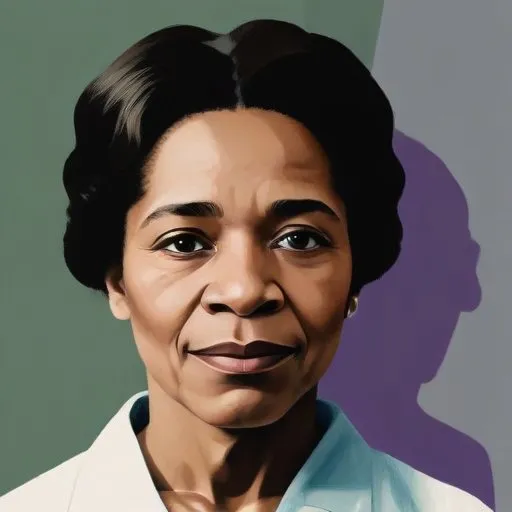
Pioneering educator and civil rights activist who developed literacy and citizenship programs for African Americans in the rural South, playing a crucial role in the Civil Rights Movement.
Septima Poinsette Clark, affectionately known as the "Queen Mother" or "Grandmother of the Civil Rights Movement," was a pioneering educator and civil rights activist who played a pivotal role in the fight for voting rights and civil rights for African Americans in the United States. Through her groundbreaking literacy and citizenship workshops, Clark empowered marginalized communities to demand their rights and challenge the status quo.
Born on May 3, 1898, in Charleston, South Carolina, Clark grew up in a city strictly segregated and divided by class. Her father, Peter Poinsette, was once enslaved on a plantation, while her mother, Victoria Warren Anderson Poinsette, was born in Charleston but raised in Haiti. Clark's parents instilled in her a strong sense of determination and self-worth, which would later define her approach to education and activism.
Clark's educational journey began at the Avery Normal Institute in Charleston, where she graduated in 1916. She went on to attend Columbia University, earning a degree in education in 1942. Clark's teaching career spanned over 30 years, during which she worked in various schools in the South, often facing racism and sexism. Her experiences as a teacher deeply influenced her philosophy on education, which emphasized the importance of literacy and community empowerment.
Clark's most significant contribution to the Civil Rights Movement was the development of literacy and citizenship workshops, which she conducted across the South in the 1950s and 1960s. These workshops taught African Americans to read and write, enabling them to register to vote and exercise their civic rights. Clark's approach focused on empowering individuals and communities, rather than relying solely on legal reforms.
Clark's work was instrumental in the success of the Civil Rights Movement. Her literacy and citizenship workshops played a crucial role in the drive for voting rights and civil rights. Martin Luther King Jr. frequently referred to Clark as "The Mother of the Movement," acknowledging her significant contributions. Clark's work inspired a new generation of civil rights leaders, including SNCC (Student Nonviolent Coordinating Committee) and SCLC (Southern Christian Leadership Conference) activists.
Clark's philosophy on education and social change emphasized the importance of empowering marginalized communities. She believed that knowledge and literacy were essential tools for individuals to claim their rights and challenge systemic oppression. Clark's approach was rooted in a deep understanding of the African American experience and the need for collective action and community empowerment.
Clark received numerous awards and honors for her contributions to education and civil rights, including the Martin Luther King Jr. Award and the National Education Association's Human and Civil Rights Award.
Septima Poinsette Clark's legacy extends far beyond her own lifetime. Her work continues to inspire educators, activists, and community leaders today. Clark's emphasis on empowerment, literacy, and community action remains a powerful testament to the importance of grassroots activism and social change.
Born in 1903
A behind-the-scenes leader in the Civil Rights Movement, known for grassroots organizing and empowering others to take action, particularly through the Student Nonviolent Coordinating Committee (SNCC).
Born in 1913
Refused to give up her seat on a Montgomery, Alabama bus to a white person, sparking the Montgomery Bus Boycott, a pivotal event in the Civil Rights Movement.
97 Years Old
A prominent leader in the civil rights movement, advocating for racial equality and social justice through nonviolent means, leaving a lasting impact on American history.
Born in 1926
A prominent leader in the American Civil Rights Movement, he worked closely with Martin Luther King Jr. to advocate for racial equality and social justice through nonviolent means.
Born in 1912
A pioneering civil rights activist who played a key role in organizing the 1963 March on Washington, where Martin Luther King Jr. delivered his iconic "I Have a Dream" speech.
Born in 1912
A pioneering figure in the struggle for racial and gender equality, she dedicated her life to empowering African American women and promoting education and social justice.
Born in 1924
A trailblazing African American congresswoman who broke racial and gender barriers, advocating for education, women's rights, and the poor. She was the first woman to run for the Democratic presidential nomination in 1972.
94 Years Old
A prominent civil rights leader and diplomat who served as a key advisor to Martin Luther King Jr. and later became the first African American to hold a top post in an American presidential administration.
