


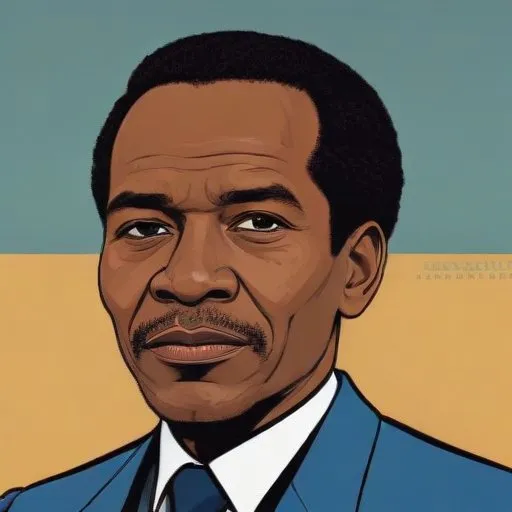
The first president of Botswana, a key figure in the country's transition to independence from British colonial rule, and a champion of African nationalism. He's known for his courageous fight against racism and colonialism.
Seretse Khama was a trailblazing Botswana politician who made history by becoming the country's first President, a position he held from 1966 until his untimely death in 1980. He was a champion of independence, leading his country's transition from British rule to self-governance, and his legacy continues to inspire generations of Africans and beyond.
Born on July 1, 1921, in Serowe, Bechuanaland (now Botswana), Seretse Khama was part of the revered Bamangwato clan of the Tswana people. His name, which means "the clay that binds," symbolized the reconciliation between his father and grandfather, securing his own future ascension to the throne. Following his father's death in 1925, four-year-old Seretse became kgosi (king), with his uncle Tshekedi Khama serving as his regent and guardian.
Seretse's education took him to the Tiger Kloof Educational Institute in South Africa and later to Fort Hare University College, where he was exposed to ideas of liberation and self-determination. During his time in the UK, he met and married Ruth Williams, an Englishwoman, in 1948. This union sparked controversy, as the apartheid regime in South Africa and the British government opposed their interracial marriage, leading to Seretse's exile in England.
In 1956, Seretse returned to Bechuanaland and began to mobilize his people for independence. He founded the Botswana Democratic Party (BDP) in 1962, which won a landslide victory in the 1965 general elections, making him the country's first Prime Minister. On September 30, 1966, Botswana gained independence, and Seretse Khama was elected as its first President.
During his presidency, Botswana experienced rapid economic and social progress. Khama's government invested in education, healthcare, and infrastructure, transforming the country into one of Africa's most stable democracies. His leadership also saw the country's diamond industry flourish, contributing to its economic growth.
Seretse Khama's story is a testament to the power of perseverance and vision. His leadership and diplomatic skills played a crucial role in Botswana's transition to independence, and his presidency set the country on a path of economic growth and democratic stability. Today, he is remembered as a hero and a symbol of African liberation.
"The future of our country lies in the unity of our people. We must avoid any form of tribalism, sectionalism, or factionalism."
86 Years Old
Botswana's third President, an economist and politician, led the country's economic growth and HIV/AIDS mitigation efforts, earning international recognition and praise.
73 Years Old
A former army general who led Botswana to economic prosperity and stability, known for his anti-corruption efforts and commitment to conservation.
Born in 1925
The former Vice-President of Botswana who played a crucial role in the country's transition to independence and democracy, and later served as the Chairman of the International Panel of Eminent Personalities to investigate the 1994 Rwandan genocide.
