


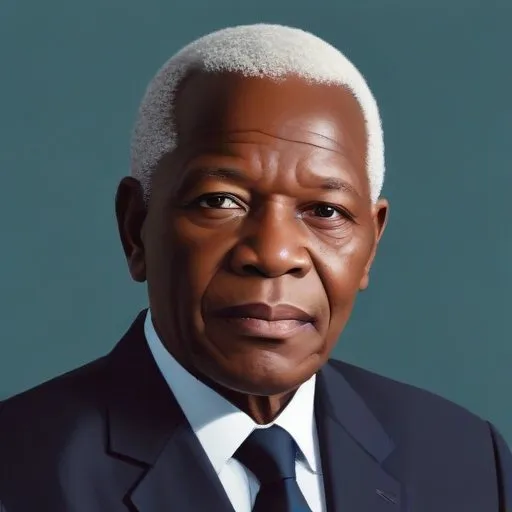
The former Vice-President of Botswana who played a crucial role in the country's transition to independence and democracy, and later served as the Chairman of the International Panel of Eminent Personalities to investigate the 1994 Rwandan genocide.
Quett Masire, the second and longest-serving president of Botswana, is hailed as the architect of the country's remarkable economic growth and development. From 1980 to 1998, he steered the nation towards a path of prosperity, earning himself an honorary knighthood of the Grand Cross of Saint Michael and George from Queen Elizabeth II in 1991.
Born on July 23, 1925, in Kanye, Botswana, Masire grew up in a cattle-herding family during a time of limited economic opportunities. Despite the challenges, he excelled academically, earning a scholarship to the Tiger Kloof Educational Institute in South Africa after graduating at the top of his class at the Kanye school.
In 1950, Masire co-founded the Seepapitso II Secondary School, the first institution of higher learning in the Bangwaketse Reserve, and served as its headmaster for six years. His efforts to promote education and autonomy for protectorate schools clashed with the autocratic Bangwaketse ruler, Bathoen II. This early conflict laid the groundwork for Masire's future advocacy for accountability and transparency in governance.
In 1957, Masire earned a Master Farmers Certificate, establishing himself as a leading agriculturalist in the territory. His innovative farming practices led to renewed conflict with Bathoen, who seized his farms in a misguided attempt to curtail his influence. Undeterred, Masire continued to promote agricultural development, laying the foundation for Botswana's future economic growth.
As president, Masire implemented policies that fostered economic stability, encouraged foreign investment, and promoted human development. He played a crucial role in protecting Botswana's natural resources, including diamonds, and invested in infrastructure development, education, and healthcare. His vision for a prosperous Botswana has inspired generations of leaders and citizens alike.
Masire's commitment to education, economic development, and good governance has left an indelible mark on Botswana's society. His legacy serves as a beacon of hope for African leaders, showcasing the importance of visionary leadership in driving economic growth and human development.
Ketumile Quett Joni Masire's remarkable life and legacy serve as a testament to the power of visionary leadership, education, and determination. His contributions to Botswana's development have left an enduring impact on the nation and the world.
Born in 1918
A South African lawyer and politician who fought against apartheid, becoming the country's first black president and a symbol of racial reconciliation, earning a Nobel Peace Prize. He's a beacon of hope and freedom.
Born in 1922
First President of Tanzania, led the country to independence from British colonial rule and implemented socialist policies, known for his Pan-Africanism and anti-colonialism efforts.
Born in 1909
First President of Ghana, leading the country to independence from British colonial rule and promoting Pan-Africanism. He's known for his vision of a united Africa and his role in shaping modern Ghana.
Born in 1924
The 2nd President of Zimbabwe, a controversial figure who ruled with an iron fist, known for his country's economic downfall and human rights abuses.
89 Years Old
A Nigerian general and politician who served as the 5th President of Nigeria, known for his efforts to stabilize the country's economy and promote democracy. He's also known for his role in brokering peace in several African countries.
84 Years Old
The second President of South Africa, a key figure in the country's transition from apartheid to democracy, known for his economic reforms and HIV/AIDS controversy.
