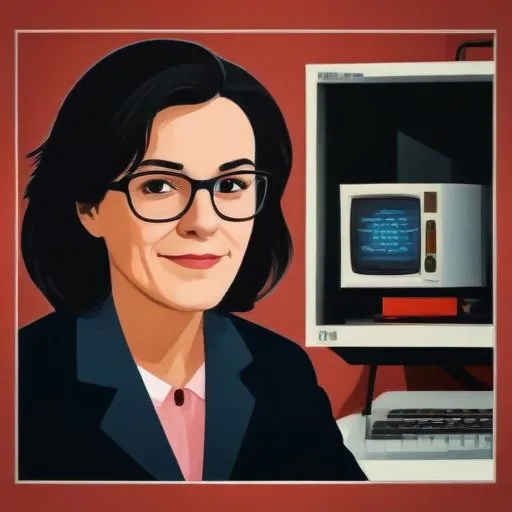
Sheila Greibach: A Pioneer in Formal Languages and Computer Science
A Legacy in Context-Sensitive Parsing
Sheila Greibach is a renowned American researcher in formal languages, computing, and automata theory, best known for her groundbreaking work in context-sensitive parsing using the stack automaton model. Her notable contributions to the field have earned her a prominent place in the annals of computer science, particularly with her establishment of the Greibach normal form for context-free grammars in 1965.
Early Life and Education
Born on October 6, 1939, in New York City, Greibach's academic excellence was evident from an early age. She earned an A.B. degree summa cum laude in Linguistics and Applied Mathematics from Radcliffe College in 1960, followed by an A.M. degree two years later. Her PhD thesis, "Inverses of Phrase Structure Generators," was awarded in 1963 from Harvard University, under the guidance of Anthony Oettinger.
Academic Career and Contributions
Greibach's illustrious career has spanned over five decades, with her most notable association being with the University of California, Los Angeles (UCLA). She joined UCLA in 1969, where she continues to hold the position of Emeritus Professor of Computer Science. Her work has focused on formal languages, automata theory, and compiler theory, with significant contributions to the development of context-sensitive parsing.
Some of her notable students include Ronald V. Book and Michael J. Fischer, who have gone on to make their own mark in the field of computer science.
Major Works
Greibach's contributions to the field are numerous, with some of her significant works including:
- Extended Abstract, Proceedings of the fifth annual ACM symposium on Theory of Computing, April 1973, where she explored the concept of Jump PDAs, deterministic context-free languages, principal AFDLs, and polynomial time recognition.
- Her work on W-grammars, pushdown automata, and decidability problems, which have had a lasting impact on the development of formal languages.
Influence and Legacy
Greibach's pioneering work has had a profound impact on the field of computer science, shaping the course of research in formal languages, automata theory, and compiler theory. Her contributions have inspired generations of researchers, and her work continues to influence modern computer science.
Awards and Honors
Throughout her career, Greibach has received numerous awards and honors for her contributions to computer science, including:
- Emeritus Professor of Computer Science at UCLA, a testament to her dedication and service to the university.
- Recognition for her pioneering work in context-sensitive parsing, which has become a cornerstone of computer science research.
Personal Milestones and Key Life Events
Greibach's personal milestones are a testament to her dedication to her craft. Some of her notable life events include:
- Joining the University of California, Los Angeles (UCLA) in 1969, where she has spent the majority of her academic career.
- Becoming an Emeritus Professor of Computer Science at UCLA, a recognition of her contributions to the field.
Philosophical Contributions and Beliefs
Greibach's work has been guided by her philosophical beliefs in the importance of formal languages and automata theory in shaping the future of computer science. Her contributions have been driven by her passion for understanding the intricacies of language and computation.
Impact on Modern Society
Greibach's research has had a profound impact on modern society, influencing the development of computers, programming languages, and artificial intelligence. Her work has enabled the creation of more efficient and powerful computers, which have revolutionized the way we live and work.
Greibach's legacy serves as a testament to her pioneering spirit, dedication, and contributions to the field of computer science. Her work continues to inspire and influence researchers, ensuring her place as a trailblazer in the history of computer science.
FAQ
What is Sheila Greibachs most notable contribution to computer science?
Sheila Greibachs most notable contribution to computer science is her work on the theory of algorithms, particularly in the area of automata theory and formal languages.
How did Sheila Greibach get into computer science?
Sheila Greibach became interested in computer science while pursuing her undergraduate degree in mathematics, and went on to earn her Ph.D. in computer science from Harvard University.
What awards has Sheila Greibach received for her work?
Sheila Greibach has received several awards for her work, including the National Science Foundations Faculty Award for Women and the Association for Computing Machinerys (ACM) Fellow award.
What is Sheila Greibachs approach to teaching computer science?
Sheila Greibach is known for her engaging and student-centered approach to teaching computer science, which emphasizes hands-on learning and real-world applications.
How has Sheila Greibach contributed to increasing diversity in computer science?
Sheila Greibach has been a vocal advocate for increasing diversity in computer science, particularly for women and underrepresented minorities, and has worked to create opportunities for underrepresented groups to enter the field.