


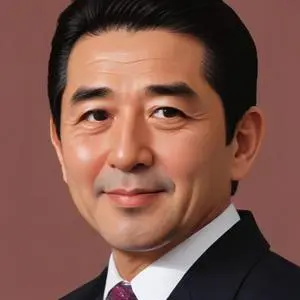
The first Japanese leader to visit Pearl Harbor, he strengthened Japan's economy and international relations through bold policies and diplomatic efforts. He's known for his nationalist views and efforts to revise Japan's pacifist constitution.
Shinzo Abe, the longest-serving prime minister in Japanese history, left an indelible mark on the country's politics and economy. With a combined tenure of almost nine years, Abe's leadership was characterized by his commitment to conservative values, economic reforms, and international relations.
Born into the prominent Sat-Kishi-Abe family, Abe's path to politics was paved by his grandfather, Prime Minister Nobusuke Kishi. After graduating from Seikei University and briefly attending the University of Southern California, Abe was elected to the Japanese House of Representatives in 1993.
Abe's rise to prominence was swift, and he became Chief Cabinet Secretary under Prime Minister Junichiro Koizumi in 2005. His tenure was marked by significant reforms, including the privatization of the postal system and the strengthening of Japan's relations with the United States.
In 2006, Abe succeeded Koizumi as prime minister and president of the Liberal Democratic Party (LDP). At 52, he became Japan's youngest post-war prime minister and the first born after World War II. Abe's focus on economic growth, education reform, and constitutional revision resonated with the Japanese people, earning him widespread support.
After a brief hiatus due to health issues, Abe staged an unexpected comeback in 2012, defeating Shigeru Ishiba to become LDP president. The LDP's landslide victory in the general election that year paved the way for Abe's return to the prime minister's office.
Abe's second stint as prime minister was marked by significant economic reforms, including the introduction of "Abenomics," a series of policies aimed at stimulating Japan's economy through monetary easing, fiscal stimulus, and structural reforms.
Abe's personal life was marked by his strong sense of family and tradition. He was married to Akie Abe, a socialite and former radio DJ, and was known for his love of Japanese cuisine and traditional culture.
Abe's legacy is complex and multifaceted. While he is credited with stimulating Japan's economy and strengthening its international relations, he is also criticized for his stance on historical issues, including the comfort women controversy.
In the end, Abe's commitment to his country and his people is undeniable. As Japan's longest-serving prime minister, he leaves behind a legacy that will be debated and examined for generations to come.
69 Years Old
The 62nd Prime Minister of Japan, a lawyer-turned-politician who led the country from 2011 to 2012, known for his efforts to rebuild Japan after the devastating Fukushima nuclear disaster. He's also recognized for increasing the country's consumption tax to tackle its massive debt.
79 Years Old
The 61st Prime Minister of Japan, a lawyer-turned-politician who led the country during the 2011 Fukushima Daiichi nuclear disaster, implementing reforms and advocating for renewable energy. He's known for his efforts to phase out nuclear power and promote sustainable energy.
84 Years Old
The 56th Prime Minister of Japan, serving from 2001 to 2006, known for his economic reforms, privatization of the postal system, and bold foreign policy initiatives. He's also famous for his flamboyant hairstyle and love of Elvis Presley music.
86 Years Old
A Japanese target shooter turned politician who served as the country's 92nd Prime Minister, known for his brief yet tumultuous tenure marked by scandals and controversies.
90 Years Old
The 91st Prime Minister of Japan, serving from 2007 to 2008, known for his efforts to address climate change and improve Japan's relations with its Asian neighbors. He's also remembered for his unexpected resignation after only a year in office.
