


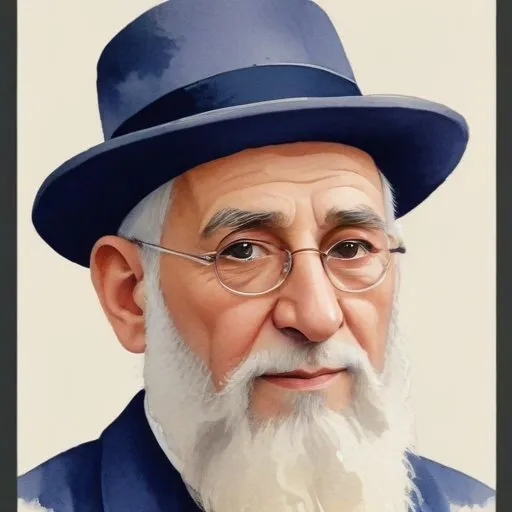
A Polish-born Israeli rabbi and military leader who played a key role in the 1967 Six-Day War, capturing the Western Wall and reuniting Jerusalem under Israeli control. He later became the Ashkenazi Chief Rabbi of Israel, known for his progressive views on women's rights and religious law.
Shlomo Goren, a renowned Polish-born Israeli rabbi and Talmudic scholar, is best known for his immense contributions to Jewish religious law (halakha) and his distinguished military career as the first head of the Military Rabbinate of the Israel Defense Forces (IDF). As a foremost rabbinical legal authority, Goren played a pivotal role in shaping Israel's religious landscape, earning him the title of Chief Rabbi of Israel.
Born on February 3, 1917, in Zambrów, Poland, to an Orthodox Ashkenazi Jewish family, Goren's parents, Avraham Goronczik and Haya Tzipora, emigrated to the British Mandate for Palestine in 1925. His family was among the founders of Kfar Hasidim, an Orthodox Jewish village near Haifa, where Goren grew up. Showing prodigious talent from a young age, he was sent to study at the Etz Chaim Yeshiva in Jerusalem, and later, at the Hebron Yeshiva, where he was ordained as a rabbi at just 17 years old.
Goren's military career was marked by his commitment to Religious Zionist values. He volunteered for the Haganah in 1936 and served as a chaplain for the Jerusalem area. In 1948, he founded and led the Military Rabbinate of the IDF, a position he held until 1968. During this period, he fought in three Arab-Israeli wars and wrote several award-winning books on halakha. Goren's dedication to the IDF earned him recognition as a pioneering force in the development of Israel's military chaplaincy.
In 1972, Goren was elected as the Chief Rabbi of Israel, a position he held until 1983. During his tenure, he played a crucial role in shaping the country's religious policies and fostering greater understanding between religious and secular Israelis. His commitment to Religious Zionist values and his dedication to the Jewish community earned him widespread respect and admiration.
Goren's philosophical contributions focused on the intersection of Jewish law and modern society. He believed in the importance of adapting halakha to the needs of the modern Israeli state, while remaining true to the principles of Orthodox Judaism. His work in this area has had a lasting impact on Israel's religious landscape, shaping the country's approach to issues such as marriage, conversion, and religious education.
Shlomo Goren's life was a testament to the power of scholarship, service, and dedication. His contributions to Jewish religious law, his military service, and his public leadership have left an indelible mark on Israel's religious and cultural landscape. As a towering figure in Israeli society, Goren's legacy continues to inspire generations of scholars, rabbis, and community leaders.
Through his remarkable life, Goren demonstrated the importance of balancing tradition and modernity, fostering greater understanding between religious and secular Israelis, and promoting the values of Religious Zionism. His impact on Israel's religious landscape is immeasurable, and his contributions will continue to shape the country's future for generations to come.
Born in 1913
A Belarusian-born Israeli politician who served as Prime Minister of Israel and was awarded the Nobel Peace Prize for his efforts to establish a peace treaty with Egypt. He's known for his strong leadership and commitment to Israeli security.
Born in 1915
The 7th Prime Minister of Israel, serving from 1983 to 1984 and again from 1986 to 1992, known for his hardline stance on Palestinian territories and role in shaping Israel's foreign policy.
98 Years Old
The 11th Prime Minister of Israel, a military leader who played a key role in shaping the country's history, known for his controversial yet influential decisions that continue to impact the Middle East.
84 Years Old
A decorated military leader who later navigated Israel's complex political landscape as Prime Minister, known for his efforts to resolve the Israeli-Palestinian conflict.
76 Years Old
The 9th Prime Minister of Israel, a dominant figure in Israeli politics, known for his strong leadership and controversial policies. He has been a central figure in shaping Israel's foreign policy and security strategy.
Born in 1922
A renowned Israeli leader and peacemaker who played a crucial role in shaping the country's history and was awarded the Nobel Prize for his efforts towards peace in the Middle East.
Born in 1923
A Nobel Peace Prize winner who served as Israel's President and Prime Minister, known for his efforts to bring peace to the Middle East through diplomatic negotiations.
Born in 1915
A renowned Israeli military leader and statesman who played a key role in shaping Israel's foreign policy and defense strategy, known for his iconic eye patch and daring military operations.
