


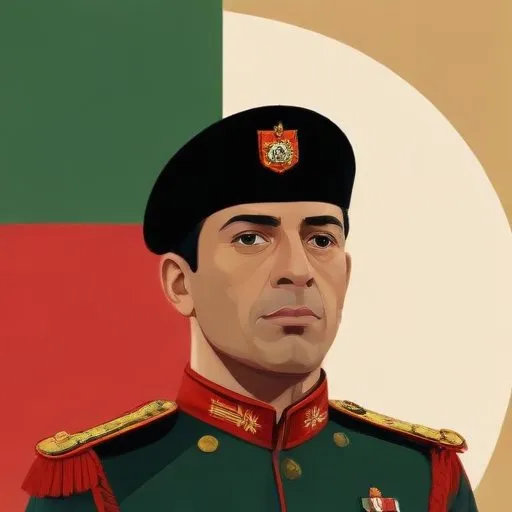
A Portuguese military officer who seized power in a coup and ruled as a dictator, known for his authoritarian regime and eventual assassination.
Sidnio Bernardino Cardoso da Silva Pais, a name that echoes through the annals of Portuguese history, was born on May 1, 1872, in Caminha, Portugal. This enigmatic figure would go on to leave an indelible mark on the country's politics, earning him the moniker "President-King."
Pais was the eldest child of Sidnio Alberto Marrocos Pais, a notary of Jewish descent, and Rita Jlia Cardoso da Silva. His early life was marked by a passion for learning, and he completed his primary education in Sert, followed by secondary education at the Lyceum of Viana do Castelo.
It was during his time at the University of Coimbra that Pais's academic prowess shone brightly. He graduated in mathematics and later received his doctorate in 1898. This academic excellence paved the way for his future career as a professor at the Faculty of Differential and Integral Calculus and director of the Brotero Industrial School.
Politics beckoned, and Pais answered. During the waning years of the Portuguese Monarchy, he began to espouse republican ideals. This political awakening led him to join a masonic lodge in Coimbra, although his involvement was short-lived.
As the Portuguese Republic took shape, Pais's star continued to rise. He became a prominent figure in the country's politics, leveraging his academic credentials and military background to propel himself to the forefront of the republican movement.
In 1918, Sidnio Pais became the fourth president of the First Portuguese Republic. His presidency was marked by controversy, with critics accusing him of authoritarianism and militarism. Pais's regime, often referred to as a "dictatorship," was characterized by a blending of executive and legislative powers, leading to widespread unrest.
Despite the controversy, Pais's presidency was marked by significant reforms, including the introduction of a new constitution and the establishment of a corporatist economic system. His regime, however, was short-lived, and he was assassinated on December 14, 1918.
Sidnio Pais's philosophical contributions are often overshadowed by his political persona. However, his academic background and intellectual pursuits demonstrate a deep understanding of mathematics, philosophy, and politics. Pais's writings reveal a thinker who grappled with the complexities of modernity, nationalism, and the role of the state.
Sidnio Pais's legacy continues to shape modern Portuguese society. His presidency, though contentious, laid the groundwork for the country's transition to democracy. Pais's emphasis on corporatism and economic development has had a lasting impact on Portugal's economic landscape.
Sidnio Pais's life was a complex tapestry of politics, education, and controversy. While his presidency was marked by authoritarianism and criticism, it is undeniable that he left an indelible mark on Portuguese history. Love him or loathe him, Sidnio Pais remains an enigmatic figure, whose legacy continues to shape the country he once led.
Born in 1866
A Portuguese physician and politician who served as the 6th President of Portugal, known for his role in the country's transition from monarchy to republic. He played a key part in shaping Portugal's modern government and politics.
Born in 1871
A prominent figure in Portuguese politics, serving as Prime Minister and implementing significant reforms, particularly in education and justice. He's also known for his role in the country's transition to a republic.
