


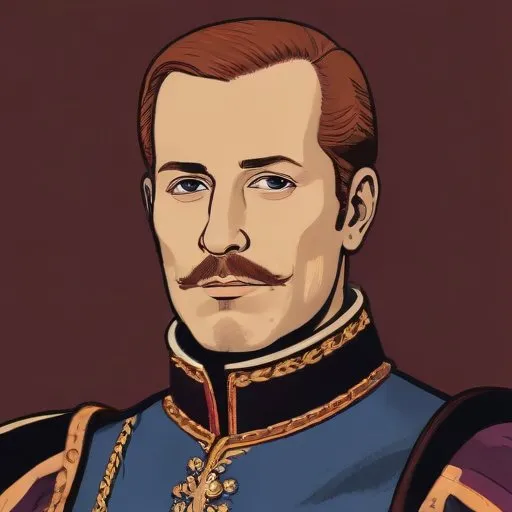
Ruler of Tyrol from 1446 to 1490, known for his cultural and economic achievements, including the establishment of the University of Innsbruck. He was a patron of the arts and architecture, leaving a lasting legacy in the region.
Sigismund, Archduke of Austria, is renowned for his unwavering leadership and expansions of the Habsburg territories, earning him the title of Duke of Austria from 1439 and Archduke in 1477 until his demise in 1496. As a scion of the Habsburg Leopoldian line, he left an indelible mark on the history of Austria, particularly in the regions of Further Austria and the County of Tyrol.
Born on October 26, 1427, in the Tyrolean court of Innsbruck, Sigismund was the son of Frederick IV of Austria and his second wife, Anna of Brunswick. Following his father's death in 1439, his first cousin, Frederick V, acted as regent until 1446, exploiting opportunities to expand his influence over the Further Austrian lands. The Inner Austrian duke's interference in the Old Zürich War sought to regain former Habsburg territories lost to the Swiss Confederacy, while the Tyrolean nobles urged him to cede the rule to Sigismund.
In 1446, upon the end of his regency, Sigismund finally acceded to rulership over the Further Austrian Vorderösterreich possessions, including the Swabian territories of the Sundgau in southern Alsace, the Breisgau, and numerous smaller estates. The mines of Tyrol remained a vital source of revenue for him. He acquired large parts of the former County of Bregenz in present-day Vorarlberg in 1451 and further estates in the Großwalsertal and Kleinwalsertal.
Sigismund's cousin had planned to marry him off to the French princess Radegonde, daughter of King Charles VII the Victorious, but she died in 1445. Instead, he married Princess Eleanor of Scotland, daughter of King James I, on September 8, 1449, in an Augustinian church near Chinon, represented by Ludwig von Landsee. This union strengthened the ties between the Habsburg and Scottish royal families.
Sigismund's unwavering dedication to the Habsburg dynasty and his strategic expansions of the territories have left a lasting impact on the history of Austria. His reign marked a significant turning point in the Habsburg Leopoldian line, cementing the dynasty's influence over the region. As a testament to his leadership, Sigismund's legacy continues to shape the course of Austrian history, inspiring future generations of Habsburg rulers.
In conclusion, Sigismund, Archduke of Austria, was a shrewd leader who navigated the complexities of the Habsburg dynasty with finesse, expanding the territories and securing the legacy of the Leopoldian line. His unwavering commitment to the Habsburgs has left an indelible mark on Austrian history, cementing his place as one of the most notable rulers of the dynasty.
Born in 1643
A 17th-century nobleman who ruled Lorraine and played a significant role in the Thirty Years' War, known for his military campaigns and territorial expansions.
Born in 1478
The King of Castile and ruler of Burgundy, known for his lavish spending and cultural achievements, including the construction of the Palace of Coudenberg in Brussels.
Born in 1505
Governor of the Habsburg Netherlands, known for her strong leadership and cultural patronage, fostering a golden age of arts and literature.
Born in 1793
Emperor of Austria from 1835 to 1848, known for his role in the Revolutions of 1848 and his abdication in favor of his nephew Franz Joseph.
