


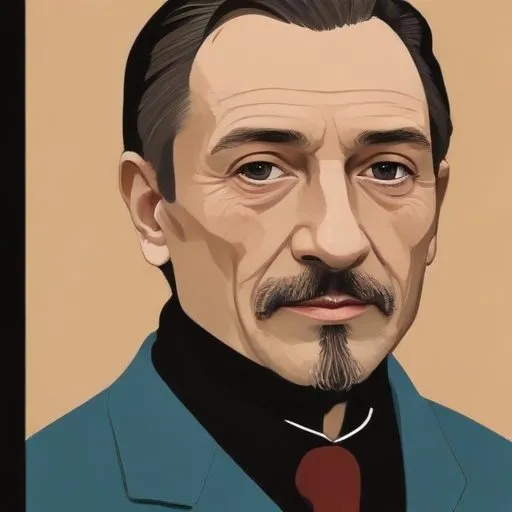
A Hungarian painter and graphic designer who blended traditional folk art with modernist styles, creating vibrant and stylized works that captured the essence of urban life.
Sándor Bortnyik was a renowned Hungarian painter and graphic designer, best known for his influential work in the early 20th century that blended the styles of Cubism, Expressionism, and Constructivism. His iconic commercial posters, particularly the advertising images for Modiano cigarette papers, continue to be celebrated for their innovative design and timeless appeal.
Born on July 3, 1893, in Trgu Mure, Transylvania (now part of Romania), Bortnyik's artistic journey began in his early years. He moved to Weimar, Germany, in 1922, where he connected with the Bauhaus movement, a hub for avant-garde artists and designers.
Bortnyik's association with Bauhaus had a profound impact on his work. He absorbed the principles of functional design, simplicity, and minimalism, which later became the hallmark of his commercial posters. This exposure also instilled in him a passion for teaching, leading him to establish his own art school, the Workshop in Budapest, upon his return to Hungary.
Bortnyik's contributions to the world of graphic design were recognized during his lifetime. He served as the director of the Hungarian Academy of Fine Arts from 1949 to 1956, a testament to his esteemed status in the Hungarian art community.
Bortnyik's commercial posters, created for clients such as Modiano, are a testament to his innovative design sense. These iconic images, characterized by bold colors, geometric shapes, and minimalist compositions, continue to inspire graphic designers and artists today.
Bortnyik's work extended beyond the realm of commercial art. His avant-garde style, which blended the principles of Cubism, Expressionism, and Constructivism, influenced the development of modern Hungarian art. His contributions paved the way for future generations of artists, designers, and architects.
Bortnyik passed away on December 31, 1976, leaving behind a rich legacy in the world of graphic design and modern Hungarian art. He is buried in Kerepesi Cemetery, Budapest.
Bortnyik's life and work serve as a testament to the power of innovative design and the importance of embracing artistic movements. As we continue to celebrate his contributions, we are reminded of the enduring impact he has had on the world of graphic design and modern Hungarian art.
Born in 1895
A pioneering figure in modern art, known for blending traditional mediums with industrial materials and techniques to create innovative, avant-garde works that explored the intersection of art and technology.
Born in 1866
A pioneer of abstract art, creating vibrant, expressive works that explored the emotional and spiritual properties of color, and wrote extensively on art theory.
Born in 1878
A Ukrainian painter and theorist who founded the Suprematist movement, creating geometric abstract works that explored the emotional and spiritual properties of color. They're most known for their iconic "Black Square" painting.
Born in 1881
A pioneering artist who transformed modern art with pioneering Cubist works, creating a new visual language that continues to inspire and influence art, design, and culture.
Born in 1881
A pioneer of Cubism, this artist's bold, geometric works blended modernity with ancient forms, influencing generations of artists and designers.
Born in 1869
A pioneering artist who revolutionized modern art with bold, expressive, and colorful works that blurred the lines between painting and sculpture, creating a new language of form and color.
Born in 1887
A dreamlike painter and poet who blended fantasy and reality, creating vibrant, emotive works that explored Jewish culture and the human experience.
Born in 1885
A pioneer of Orphism, a style of abstract art that emphasizes geometric shapes and vibrant colors, creating dynamic and expressive works that explore the emotional potential of color. 42
