


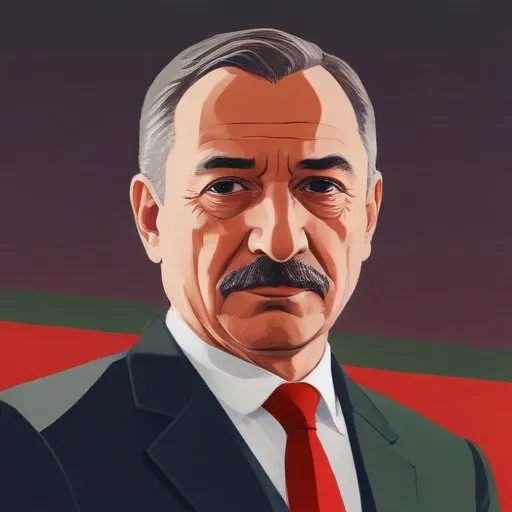
The 19th Prime Minister of Hungary, serving from 1919, known for his brief but tumultuous tenure during the Hungarian Soviet Republic, marked by radical reforms and eventual collapse.
Sndor Garbai, born on March 27, 1879, was a Hungarian socialist politician who led the Hungarian Soviet Republic as both head of state and prime minister, earning him a prominent place in the annals of Hungarian history. As the de jure leader of the short-lived Soviet Republic, Garbai played a pivotal role in shaping the country's political landscape during the tumultuous early 20th century.
Garbai was born into the family of a Protestant bricklayer, an unconventional background for a future leader. Despite the humble beginnings, he became an active participant in the labor movement at a young age, joining the Social Democratic Party of Hungary (MSZDP) in 1901. His commitment and charisma soon propelled him through the party ranks.
By 1908, Garbai had become the chairman of the Workers Insurance Fund, a position that demonstrated his dedication to the working class. During the First Hungarian Republic, he headed the All National Housing Council, further solidifying his reputation as a champion of social welfare.
In 1919, Garbai supported the merger of the MSZDP with the Hungarian Communist Party, which led to the establishment of the Hungarian Soviet Republic. As the leader of the Revolutionary Governing Council, Garbai became both head of state and prime minister, assuming a position of significant power and influence.
Although Garbai held the top office, the de facto leadership of the Soviet Republic rested with Communist foreign minister Béla Kun. Historians have noted that Kun and other Jewish leaders in the government would often joke about Garbai, a gentile, signing death sentences on Shabbat.
Following the fall of the Soviet Republic, Garbai was arrested by the Romanian military. Fearing reprisals, he escaped from captivity and fled to Czechoslovakia, eventually settling in Vienna. In exile, he became a leader of the centrist Marxist movement among Hungarian political refugees.
Garbai's entrepreneurial spirit led him to open a restaurant in Vienna, where he hosted former communist and socialist leaders. Unfortunately, the venture ultimately ended in bankruptcy, leaving Garbai to struggle with poverty for the remainder of his life.
In 1934, Garbai left Austria due to the rise of the right-wing Fatherland Front and settled in Bratislava. Four years later, he moved to Paris, where he lived until his death on November 7, 1947.
Sndor Garbai's legacy is multifaceted, marked by both triumph and tragedy. As the leader of the Hungarian Soviet Republic, he played a significant role in shaping Hungary's early 20th-century history. Despite his later struggles, Garbai remains an important figure in the country's socialist and communist movements.
Garbai's story serves as a testament to the power of conviction and the complexity of human experience. His life, marked by both idealism and hardship, continues to inspire and educate generations of Hungarians and scholars alike.
Born in 1892
A Hungarian communist leader who ruled the country with an iron fist from 1949 to 1956, known for his brutal suppression of dissent and forced industrialization.
Born in 1896
Led a reformist government in Hungary during the 1956 revolution, attempting to establish a multi-party system and withdraw from the Soviet-dominated Warsaw Pact. His efforts ultimately led to Soviet invasion and his execution.
Born in 1886
Led a communist government in Hungary after World War II, implementing Soviet-style policies and suppressing opposition. He played a key role in the country's post-war reconstruction and alignment with the Soviet Union.
Born in 1912
A Hungarian mechanic-turned-politician who served as Prime Minister of Hungary from 1956 to 1988, known for his role in crushing the 1956 Hungarian Revolution and later introducing economic reforms.
