


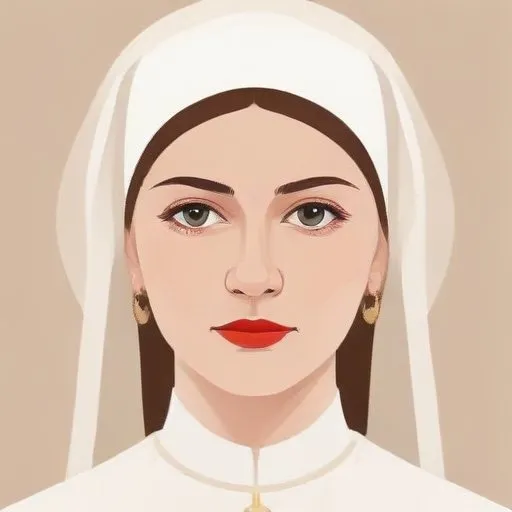
A 17th-century Eastern Orthodox saint and martyr, known for her bravery and devotion to faith amidst persecution, inspiring generations with her unwavering commitment.
Sophia Olelkovich Radziwill, a woman of unyielding spirit and multifaceted talents, is often regarded as one of the most fascinating figures of Renaissance Lithuania. Born in 1585, Sophia was a member of the Olelkovich noble family and later became a princess of the Radziwill family, one of the most influential and powerful clans in the Grand Duchy of Lithuania.
Sophia's early life was marked by a thirst for knowledge, and she received an exceptional education for a woman of her time. She was well-versed in Latin, Greek, and several modern languages, and demonstrated a particular interest in philosophy, literature, and music. Her intellectual pursuits did not go unnoticed, and she soon became a prominent figure in the cultural and social circles of Vilnius, the capital of the Grand Duchy of Lithuania.
Sophia's love for the arts led her to become a generous patron, supporting many prominent artists, writers, and thinkers of her era. She was particularly drawn to the works of the Flemish-born painter, Bartholomeus Spranger, and her court became a hub for artistic innovation and creativity. Sophia's own creative talents were not limited to her patronage, as she was also an accomplished poet and translator, producing several works in Latin and Polish.
Sophia's marriage to Janusz Radziwill, the Chancellor of Lithuania, catapulted her into the heart of politics. She played a significant role in shaping her husband's policies and was known for her diplomatic prowess, often acting as an envoy between the Grand Duchy of Lithuania and neighboring states. Sophia's influence extended beyond the realm of politics, as she was also a devoted philanthropist, supporting various charitable causes and institutions throughout her lifetime.
Sophia Olelkovich Radziwill's contributions to Lithuanian history and culture are immeasurable. Her unwavering dedication to the arts, education, and philanthropy has inspired generations of Lithuanians. Though her life was cut short by her untimely death in 1612, Sophia's legacy continues to captivate historians and scholars, offering a fascinating glimpse into the lives of women in Renaissance Lithuania.
In a world where women's voices were often silenced, Sophia Olelkovich Radziwill's remarkable achievements serve as a testament to her unyielding spirit and determination. Her story is a beacon of inspiration, illuminating the path for future generations of women who dared to defy convention and forge their own paths.
Born in 1427
Unified the Kingdom of Poland and the Grand Duchy of Lithuania, creating a powerful state that lasted for centuries. He's also known for his military campaigns and territorial expansions.
Born in 1629
The Polish-Lithuanian king who led the Polish-Lithuanian Commonwealth to victory against the Ottoman Empire in the Battle of Vienna in 1683, saving Europe from Ottoman conquest. He's also known for his military prowess and cultural achievements.
Born in 1566
The Polish and Swedish monarch who ruled from 1587 to 1632, known for his attempts to restore Catholicism in Sweden and his involvement in the Polish-Lithuanian Commonwealth's Golden Age. He played a significant role in shaping the fate of Eastern Europe during the 17th century.
