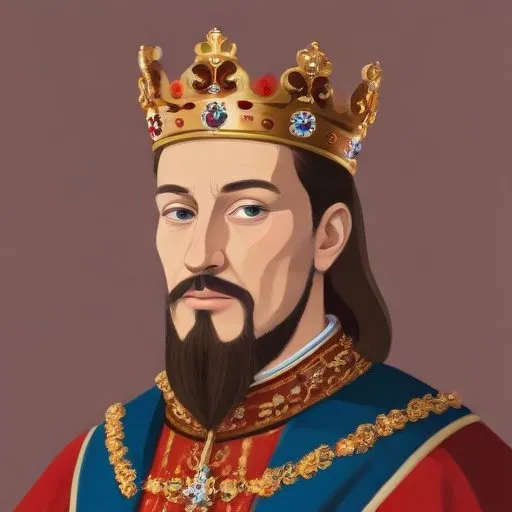
Casimir IV Jagiellon: The Architect of Poland's Golden Age
A Visionary Leader and Unifier
Casimir IV Jagiellon, also known as Kazimierz Andrzej Jagielloczyk, is remembered as one of the most influential Polish-Lithuanian rulers in history, reigning as Grand Duke of Lithuania from 1440 and King of Poland from 1447 until his death in 1492. Under his leadership, Poland defeated the Teutonic Knights in the Thirteen Years War, recovering Pomerania, and brought Prussia under Polish rule, cementing his legacy as a unifier and a shrewd diplomat.
Early Life and Accession
Born on November 30, 1427, Casimir was the third and youngest son of King Władysław II Jagiełło and his fourth wife, Sophia of Halshany. Despite being viewed as an unlikely successor by his mentor, Bishop Zbigniew Olenicki, Casimir proved to be an astute leader, relying on his instinct and feelings to navigate the complex world of diplomacy and economics.
Major Accomplishments
- Thirteen Years War and the Recovery of Pomerania: Casimir's most notable achievement was the defeat of the Teutonic Knights, securing Poland's borders and reclaiming Pomerania, a vital region that had been lost for centuries.
- Unification of Poland and Lithuania: Through a series of strategic alliances and marriages, Casimir brought Prussia under Polish rule, strengthening the Polish-Lithuanian union and establishing a powerful eastern European empire.
- Promotion of Trade and Commerce: Casimir encouraged trade and commerce, stimulating economic growth and development throughout Poland and Lithuania.
Awards and Honors
Casimir IV Jagiellon was a recipient of the prestigious English Order of the Garter (KG), the highest order of chivalry and the most esteemed honor in England.
Legacy and Impact
Casimir's reign marked the beginning of Poland's Golden Age, a period of significant cultural, economic, and political growth. His legacy extends beyond the borders of Poland and Lithuania, as he played a crucial role in shaping the European landscape of the 15th century.
Personal Life and Family
Casimir married Elizabeth of Austria, with whom he had six sons and seven daughters. His sons, including
John I Albert and
Alexander Jagiellon, went on to become prominent figures in Polish and Lithuanian politics.
Historical Context and Comparative Analysis
Casimir's reign coincided with the rise of new monarchies in Western Europe, during which Poland emerged as a significant power in international relations. His achievements can be compared to those of his contemporaries, such as King
Louis XI of France and King
Ferdinand II of Aragon, who also sought to consolidate power and expand their territories.
Trivia and Fun Facts
- Casimir IV Jagiellon was known for his exceptional height, standing over 6 feet tall, a rare trait in medieval Europe.
- He was a strong supporter of education and encouraged the establishment of universities throughout Poland and Lithuania.
Conclusion
Casimir IV Jagiellon's remarkable achievements and visionary leadership have left an indelible mark on Polish and Lithuanian history. As a unifier, diplomat, and champion of trade and commerce, he paved the way for Poland's Golden Age, cementing his place as one of the most revered figures in Eastern European history.
FAQ
Who was Casimir IV Jagiellon?
Casimir IV Jagiellon was King of Poland and Grand Duke of Lithuania from 1447 to 1492. He was a member of the Jagiellonian dynasty and played a significant role in the history of Eastern Europe.
What were Casimir IV Jagiellons achievements as King of Poland?
Casimir IV Jagiellon achieved several notable successes as King of Poland, including the incorporation of the Duchy of Masovia into the Polish Crown, the annexation of the Teutonic Orders territories, and the establishment of a strong centralized government.
What was Casimir IV Jagiellons role in the Polish-Lithuanian Union?
Casimir IV Jagiellon played a crucial role in strengthening the Polish-Lithuanian Union, which was established by his predecessors. He worked to create a more unified state by promoting the use of Polish as the official language and encouraging the adoption of Polish culture.
What were Casimir IV Jagiellons foreign policy achievements?
Casimir IV Jagiellon achieved significant foreign policy successes, including the establishment of alliances with neighboring states, the conclusion of the Peace of Thorn, and the strengthening of trade relationships with the Hanseatic League.
What was Casimir IV Jagiellons legacy?
Casimir IV Jagiellons legacy is that of a strong and effective ruler who played a significant role in shaping the history of Poland and Lithuania. He strengthened the Polish state, promoted economic development, and established a foundation for future growth and prosperity.