


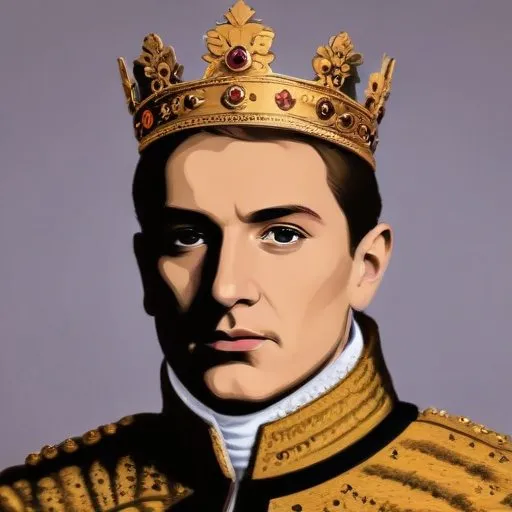
The last Jagiellonian king of Poland, known for his efforts to strengthen the Polish-Lithuanian union and defend against the Teutonic Knights. He also played a key role in the Polish-Ottoman War.
Alexander Jagiellon, a member of the esteemed House of Jagiellon, was a prominent figure in Eastern European history, serving as the Grand Duke of Lithuania from 1492 and King of Poland from 1501 until his death in 1506. He is renowned for his valiant efforts to protect Lithuania from the threats of the Grand Duchy of Moscow and his endeavors to establish peace in the region.
Born on August 5, 1461, Alexander was the fourth son of Casimir IV Jagiellon, King of Poland, and Elisabeth, daughter of King Albert of Hungary. Following the death of his father in 1492, Alexander's eldest brother, Vladislaus, had already become King of Bohemia and Hungary, while his next oldest brother, Casimir, had passed away in 1484 after leading a pious life. As a result, Alexander's brother, John I Albert, was chosen by the Polish nobility to be the next King of Poland, while the Lithuanians elected Alexander as their Grand Duke.
Upon assuming control of the Grand Duchy of Lithuania, Alexander faced a significant challenge in the form of an attack by Grand Duke Ivan III of Russia and his allies, the Tatars of the Crimean Khanate. This conflict commenced shortly after Alexander's accession and continued to threaten the region. In an effort to establish peace, Alexander sent a delegation to Moscow to negotiate a settlement, which was signed in 1494. The treaty ceded extensive land to Ivan III, but the peace was short-lived, as Ivan III resumed hostilities in 1500.
In response to the Russian aggression, Alexander launched a series of military campaigns to protect Lithuania's borders. Despite these efforts, he was ultimately forced to cede more land to Ivan III. In addition to his military efforts, Alexander also engaged in diplomatic maneuvers to establish alliances and secure peace in the region. His marriage to Helena, the daughter of Ivan III, in 1495 was a key component of this strategy, although it failed to bring lasting peace.
Alexander Jagiellon's legacy is marked by his unwavering dedication to protecting Lithuania and his efforts to establish peace in a tumultuous region. His military campaigns and diplomatic efforts, although not always successful, demonstrate his commitment to his people and his territory. As Grand Duke of Lithuania and King of Poland, Alexander played a significant role in shaping the course of Eastern European history, and his legacy continues to influence the region to this day.
Alexander Jagiellon's legacy extends beyond his own lifetime, with his diplomatic efforts and military campaigns continuing to shape the course of Eastern European history. His struggles to protect Lithuania from Russian aggression served as a precursor to the complex geopolitics of the region, which continue to influence international relations today.
Born in 1459
Ruler of Poland and Lithuania from 1492 to 1501, known for his military campaigns and territorial expansions. He also supported the arts and education, fostering a cultural renaissance.
Born in 1467
The Polish king who ruled from 1506 to 1548, known for strengthening the Polish-Lithuanian state and promoting Renaissance culture.
Born in 1566
The Polish and Swedish monarch who ruled from 1587 to 1632, known for his attempts to restore Catholicism in Sweden and his involvement in the Polish-Lithuanian Commonwealth's Golden Age. He played a significant role in shaping the fate of Eastern Europe during the 17th century.
Born in 1629
The Polish-Lithuanian king who led the Polish-Lithuanian Commonwealth to victory against the Ottoman Empire in the Battle of Vienna in 1683, saving Europe from Ottoman conquest. He's also known for his military prowess and cultural achievements.
Born in 1670
A powerful Polish king who transformed his country into a major European power through military conquests and cultural achievements, earning him the nickname "the Strong".
