


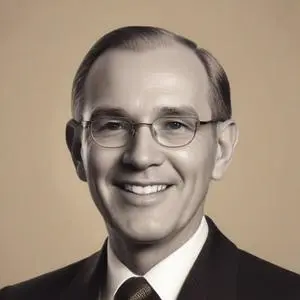
The 12th President of The Church of Jesus Christ of Latter-day Saints, a prominent religious leader who oversaw significant changes and growth within the church, and was a strong advocate for family and social values.
Spencer W. Kimball, the twelfth president of the Church of Jesus Christ of Latter-day Saints, is perhaps best known for his instrumental role in ending the restriction on church members of black African descent being ordained to the priesthood or receiving temple ordinances in 1978. During his presidency, Kimball oversaw a period of significant growth and expansion for the LDS Church, both in terms of membership and the number of temples.
Born on March 28, 1895, in Salt Lake City, Utah Territory, Kimball was the grandson of early Latter-day Saint apostle Heber C. Kimball. He spent most of his early life in Thatcher, Arizona, where his father, Andrew Kimball, farmed and served as the area's stake president. Kimball served an LDS mission in Independence, Missouri, from 1914 to 1916, and later worked for various banks in Arizona's Gila Valley as a clerk and bank teller.
In 1938, Kimball was called as a stake president in his hometown, a position he held until 1943, when he was called as a member of the Quorum of the Twelve Apostles. As an apostle, Kimball traveled extensively to fulfill a wide variety of administrative and ecclesiastical duties. Early in his time as an apostle, Kimball was directed by church president George Albert Smith to spend extra time in religious and humanitarian work with Native Americans, which Kimball did throughout his life.
Kimball was instrumental in initiating the Indian Placement Program, which helped many Native American students gain education in the 1960s and 1970s while they stayed with LDS foster families. This program was a testament to Kimball's commitment to serving others and his dedication to improving the lives of those around him.
In late 1973, following the sudden death of Harold B. Lee, Kimball became the LDS Church's twelfth president, a position he held until his death in 1985. Kimball's presidency was marked by significant growth and expansion for the LDS Church, with the number of temples increasing from 15 to 36 during his tenure. He also emphasized the importance of missionary work, stating publicly that the church expects all able-bodied male members to serve missions in young adulthood.
Spencer W. Kimball's legacy extends far beyond his presidency of the LDS Church. He is remembered for his compassion, his commitment to serving others, and his role in ending a restriction that had divided the church for over a century. Today, Kimball is celebrated as a leader of faith and compassion, whose tireless efforts to serve others continue to inspire generations of Latter-day Saints.
Kimball's life and legacy serve as a testament to the power of faith, compassion, and service. His commitment to serving others and his dedication to his faith continue to inspire and uplift countless individuals around the world.
Born in 1910
The 15th President of The Church of Jesus Christ of Latter-day Saints, a prominent religious leader who oversaw significant expansion and modernization of the church, while promoting interfaith dialogue and humanitarian efforts.
99 Years Old
The 16th President of The Church of Jesus Christ of Latter-day Saints, a prominent religious leader who guided millions of Mormons worldwide, known for his humanitarian work and spiritual guidance.
Born in 1907
The 14th President of The Church of Jesus Christ of Latter-day Saints, a prominent religious leader who played a crucial role in guiding the Mormon Church and its followers. He's known for his emphasis on spiritual growth and temple worship.
Born in 1899
The 13th President of The Church of Jesus Christ of Latter-day Saints, a prominent religious leader who served from 1985 to 1994 and was a strong advocate for conservative values and traditional morality. He's also known for his emphasis on individual freedom and self-reliance.
Born in 1873
The 9th President of The Church of Jesus Christ of Latter-day Saints, a prominent religious leader who oversaw significant church growth and expansion, while also emphasizing education and spiritual development.
Born in 1876
The 10th President of The Church of Jesus Christ of Latter-day Saints, a prominent religious leader who played a significant role in shaping the church's doctrine and policies, particularly in the areas of scripture and theology.
93 Years Old
A prominent leader in the Church of Jesus Christ of Latter-day Saints, serving as both a counselor in the First Presidency and as the church's president, while also being a prolific author and educator. He is known for his inspirational writings and devotion to his faith.
Born in 1924
A prominent leader in the Church of Jesus Christ of Latter-day Saints, he served as a guiding figure and influential teacher, shaping the faith's doctrine and policies. He's known for his conservative views and emphasis on traditional values.
