


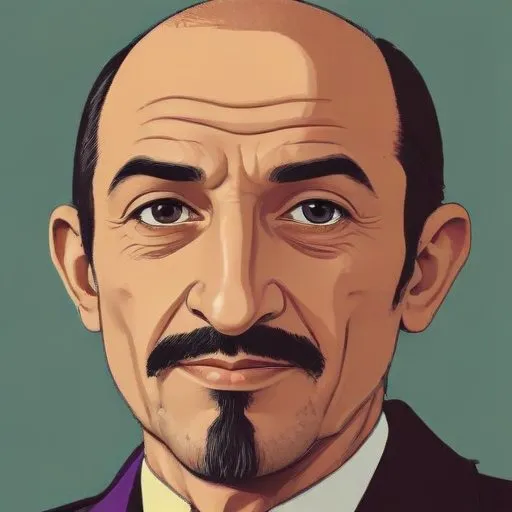
A renowned artist and educator, celebrated for his vibrant, expressive paintings that blended traditional Azerbaijani motifs with modernist techniques, earning him international recognition.
Known for his powerful and evocative works that captured the essence of Soviet life, Tahir Salahov was a renowned Azerbaijani painter and draughtsman who left an indelible mark on the art world. As the First Secretary of the Artists Union of the USSR from 1973 to 1992, Salahov played a crucial role in shaping the country's art scene and promoting the "severe style" movement, a trend that sought to depict the harsh realities of Soviet life with unflinching honesty.
Born on November 29, 1928, in Baku, Azerbaijan, Salahov's early life was marked by tragedy when his father, Teymur Salahov, was arrested and executed in 1937 during Stalin's purges. His mother, Sona, was left to raise four children on her own, and the family only learned of their father's fate in 1956, after Stalin's death.
Despite these challenges, Salahov pursued his passion for art, studying at the Azimzade Art College in Baku from 1945 to 1950 and later at the Surikov Moscow Art Institute from 1951 to 1957. It was during this period that he developed his unique style, which blended realism with a strong sense of social commentary.
Salahov's breakthrough came in 1957, when his diploma work, "The Shift is Over," was exhibited at the Moscow All-Union Art Exhibition and received widespread critical acclaim. The painting's success marked the beginning of his rise to prominence as a leading figure in Soviet art, and he soon became known for his powerful and unflinching depictions of Soviet life.
Salahov's work was characterized by a forcefulness and lack of idealization, which was reflective of the "severe style" movement, a trend that sought to depict the harsh realities of Soviet life with unflinching honesty. His compositions, such as "Repair Men" (1961) and "Portrait of Azerbaijani Composer Gara Garayev" (1960), showcased his ability to capture the essence of Soviet society with a unique blend of realism and social commentary.
Salahov's contributions to Soviet art were recognized with numerous awards and honors, including the title of People's Artist of the USSR in 1973 and People's Artist of the Azerbaijan SSR. He was also a member of over 20 academies and creative organizations worldwide, including the Russian Academy of Arts, the French Academy of Fine Arts, and the Spanish Academy of Fine Arts.
Tahir Salahov's legacy extends far beyond his impressive body of work. As a champion of the "severe style" movement, he played a crucial role in shaping the course of Soviet art and promoting a new era of realism and honesty. His influence can be seen in the work of countless artists who followed in his footsteps, and his contributions to Soviet art continue to be celebrated to this day.
Tahir Salahov's remarkable life and career serve as a testament to the power of art to shape our understanding of the world around us. As a champion of the "severe style" movement, he played a crucial role in promoting a new era of realism and honesty in Soviet art, and his contributions continue to inspire and influence artists to this day.
Born in 1923
Azerbaijan's leader who ruled with an iron fist, modernizing the country while suppressing opposition, leaving a lasting legacy in the region.
64 Years Old
The 4th President of Azerbaijan, a leader who has dominated the country's politics since 2003, known for his authoritarian rule and efforts to maintain stability in the region.
Born in 1884
Azerbaijan's first president, a key figure in the country's struggle for independence, and a prominent scholar who played a crucial role in shaping the nation's identity and politics.
Born in 1885
A renowned composer, conductor, and playwright who merged traditional Azerbaijani music with Western classical styles, creating a unique cultural identity. He's credited with founding the nation's classical music and opera traditions.
Born in 1862
A 19th-century Azerbaijani philosopher and poet, known for his satirical and humorous poetry that criticized social issues and promoted enlightenment values. His works are considered a cornerstone of Azerbaijani literature.
