


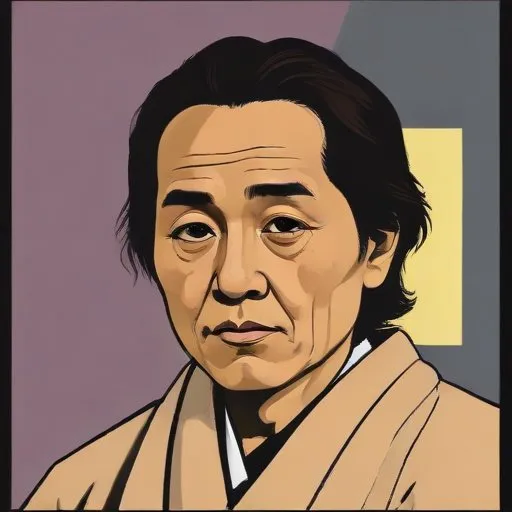
A prominent figure in Japanese literature, known for blending poetry and philosophy to explore the human condition, and critiquing modern society.
Takaaki Yoshimoto, renowned as Rymei Yoshimoto, was a Japanese poet, philosopher, and literary critic who left an indelible mark on the country's intellectual landscape. As a founding figure of the New Left in Japan, Yoshimoto's work continues to inspire and provoke, forcing writers to confront their responsibility as wartime collaborators.
Born on November 25, 1924, in Tsukishima, Tokyo, Yoshimoto was the third son of a family of boatmakers. His early life was marked by a fascination with literature, which was nurtured through private tutoring. The works of Takamura Ktar and Miyazawa Kenji had a profound impact on his worldview, shaping his poetic voice.
Yoshimoto's academic pursuits took him to Yonezawa Engineering School (now Yamagata University) and later to the Engineering Division of Tokyo Institute of Technology, where he graduated in 1947 with a degree in Electrochemistry. During this period, he befriended literary critic Takeo Okuno, with whom he shared a deep passion for literature.
After graduating, Yoshimoto entered the industrial sector, becoming a research student in 1950 and later taking a position at Tokyo Ink Manufacturing Company Ltd. in 1952. His poetic output flourished during this period, with the publication of his first representative works, Dialogue with Particularity and Ten Works for a Change in Position. His talent was recognized with the Arechi Prize for new poets.
Yoshimoto's philosophical contributions were instrumental in shaping the New Left movement in Japan. He advocated for writers to take responsibility for their role in perpetuating wartime ideologies, sparking a necessary confrontation with the country's troubled past. His work encouraged a new generation of writers to engage with the complexities of Japanese history, fostering a more nuanced understanding of the nation's cultural identity.
Yoshimoto's influence extends beyond the realm of literature, with his philosophical ideas permeating various aspects of Japanese society. His advocacy for accountability and introspection has inspired a new wave of thinkers, writers, and activists to engage with the country's complex history and cultural identity.
Takaaki Yoshimoto's legacy is a testament to the power of literature and philosophy in shaping our understanding of the world. As a pioneering figure in the New Left movement, his work continues to inspire and provoke, leaving an indelible mark on Japan's intellectual landscape. Through his writings, Yoshimoto reminds us of the importance of confronting our past, taking responsibility for our actions, and striving for a more just and equitable society.
Yoshimoto was the father of acclaimed Japanese writer Banana Yoshimoto and cartoonist Yoiko Haruno. His family life was marked by a deep love for literature and the arts, which was instilled in his children from a young age.
Takaaki Yoshimoto passed away on March 16, 2012, leaving behind a rich literary and philosophical legacy. His work continues to inspire and influence new generations of writers, thinkers, and activists, cementing his position as one of Japan's most important intellectual figures of the 20th century.
Through his life's work, Yoshimoto reminds us of the transformative power of literature and philosophy, encouraging us to engage with the complexities of our world and strive for a more just and compassionate society.
Born in 1925
A celebrated Japanese literary figure, known for his provocative and lyrical works that explored themes of identity, morality, and the human condition, often blurring the lines between reality and fantasy.
91 Years Old
A Japanese author and academic who won the Nobel Prize in Literature in 1994 for his novels and essays that blend elements of Japanese culture with Western literary traditions, exploring themes of identity, morality, and the human condition.
77 Years Old
A Japanese literary master crafting surreal, psychologically complex tales that blend fantasy and reality, exploring themes of identity, alienation, and the human condition.
Born in 1886
A celebrated author of novels and essays that explore the intersection of Japanese culture and Western modernity, known for his lyrical prose and nuanced explorations of identity.
Born in 1892
A leading figure in Japanese literature, known for his dark, psychologically complex short stories that explored the human condition, often incorporating elements of mystery and horror.
Born in 1867
A leading figure in Japanese literature, known for revitalizing haiku poetry and creating a new style that focused on everyday life and nature. His work had a significant impact on modern Japanese literature.
Born in 1867
A pioneering Japanese novelist and poet who explored the human condition, blending traditional and modernist styles to create influential works of literature.
