


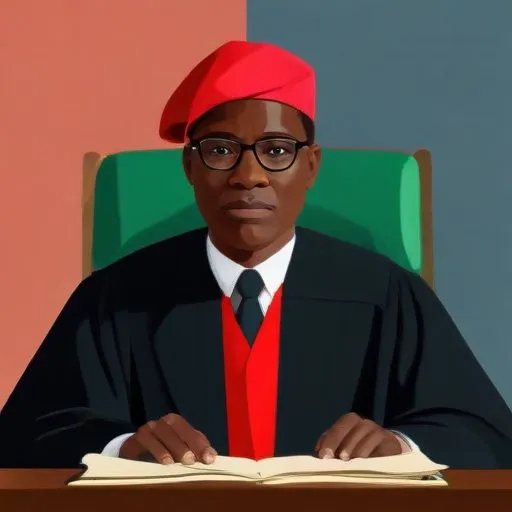
A renowned Nigerian jurist who served as the Chief Justice of Nigeria, known for his contributions to international law and human rights. He played a key role in shaping Nigeria's legal system and promoting justice in Africa.
Taslim Olawale Elias was a renowned Nigerian jurist, scholar, and statesman who left an indelible mark on the legal landscape of Nigeria and beyond. He is best known for his trailblazing efforts in modernizing and extensively revising the laws of Nigeria, a feat that earned him recognition as one of the most distinguished jurists of his time.
Born into the traditional aristocracy of Lagos on November 11, 1914, Elias received his secondary education at the Church Missionary Society Grammar School and Igbobi College in Lagos. He later worked as an assistant in the Government Audit Department before joining the Nigerian Railway, where he served in the Chief Accountant's Office for nine years.
While working at the Nigerian Railway, Elias pursued his passion for education, becoming an external student of the University of London. He passed the intermediate examinations for the BA and LLB degrees, and in 1944, he left Nigeria for the United Kingdom to further his studies. He was admitted to University College London, where he spent some time at Cambridge's Trinity College due to the wartime bombing of London.
Elias' academic excellence earned him numerous accolades. He graduated with a BA in 1945 and an LLB in 1947, and was called to the bar at the Inner Temple as a Yarborough Anderson Scholar. The same year, he received his LLM degree. In 1949, he made history as the first African to earn a PhD in law from the University of London.
His impressive academic credentials paved the way for his appointment as the Simon Senior Research Fellow at Manchester University in 1951. This was followed by a UNESCO Fellowship to research the legal, economic, and social problems of Africa. Elias' expertise and reputation as a jurist soon propelled him to the forefront of Nigeria's legal landscape.
Elias' distinguished judicial career spanned several decades. He served as Minister of Justice and Attorney-General of Nigeria from 1960 to 1966, and later as Chief Justice of Nigeria from 1972 to 1975. The pinnacle of his career came in 1982, when he was elected President of the International Court of Justice, a position he held until 1985.
Elias' remarkable contributions to the development of Nigerian law are still felt today. He played a crucial role in revising and modernizing Nigeria's laws, making them more responsive to the country's unique cultural and socio-economic context. His work in this area has had a lasting impact on the country's legal system, ensuring that it remains a cornerstone of Nigerian democracy.
Elias married Ganiat Yetunde Fowosere, and the couple had five children together – three sons, including Olufemi Elias, a lawyer, and two daughters. Despite his many achievements, Elias remained humble and dedicated to his family throughout his life.
Taslim Olawale Elias' remarkable life and achievements have been recognized with numerous honors. He received several honorary doctorates from renowned universities, including the University of Lagos and the University of Buckingham. His legacy continues to inspire generations of lawyers, judges, and scholars, cementing his place as one of the most distinguished jurists of the 20th century.
Taslim Olawale Elias' remarkable life, marked by his tireless pursuit of excellence and his unwavering dedication to the development of Nigerian law, serves as a shining example to generations of legal professionals and scholars. His legacy continues to inspire and shape the course of legal history, ensuring that his impact will be felt for years to come.
Born in 1904
First President of Nigeria, leading the country to independence from British colonial rule and shaping its early years as a sovereign nation.
89 Years Old
A Nigerian general and politician who served as the 5th President of Nigeria, known for his efforts to stabilize the country's economy and promote democracy. He's also known for his role in brokering peace in several African countries.
68 Years Old
The first president in Nigeria to originate from the minority ethnic group, he's known for his efforts to reform the country's electoral system and his handling of the Boko Haram insurgency.
91 Years Old
Led Nigeria through a tumultuous period, including a civil war, and implemented policies to unify the country. He's known for his efforts to rebuild and stabilize Nigeria after the war.
Born in 1925
The 6th President of Nigeria, who served from 1979 to 1983, is known for being the first democratically elected president in the country's history and for his efforts to rebuild the nation after a long period of military rule.
