


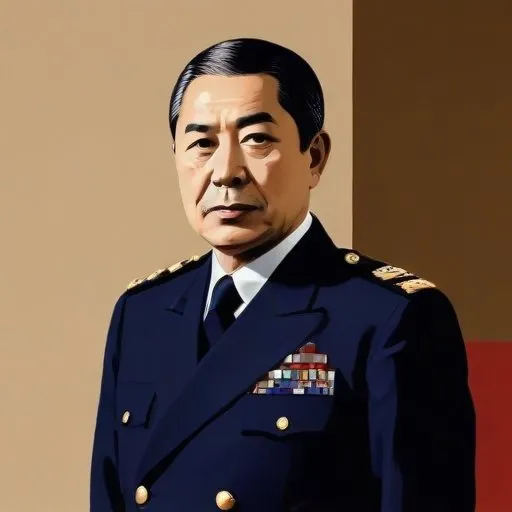
A Japanese field marshal and politician who served as the 9th Prime Minister of Japan, known for his role in Japan's military expansion and colonial rule in Asia during the early 20th century.
Terauchi Masatake, a Japanese military officer and politician, is revered for his remarkable career as a Gensui or Marshal in the Imperial Japanese Army and his tenure as the Prime Minister of Japan from 1916 to 1918. Under his leadership, Japan witnessed significant military modernization and expansion, cementing its position as a major world power.
Born on February 5, 1852, in Hirai Village, Suo Province (present-day Yamaguchi city, Yamaguchi Prefecture), Terauchi was the third son of Utada Masasuke, a samurai in the service of Chōshū Domain. He was later adopted by his maternal relative, Terauchi Kanuemon, and took on the Terauchi family name. This early familial connection would pave the way for his future rise to prominence.
As a young man, Terauchi joined the Kiheitai militia in 1864 and fought in the Boshin War against the Tokugawa shogunate from 1867. His bravery in the Battle of Hakodate earned him recognition, and he was subsequently invited to Kyoto to join the Ministry of War. It was during this period that he received training from French instructors in Western weaponry and tactics, laying the foundation for his future military achievements.
Terauchi's military career was marked by successive promotions and key appointments. He became a member of Emperor Meiji's personal guard in 1870 and accompanied the Emperor to Tokyo. After a brief stint in language studies, he was recalled to military service with the formation of the Imperial Japanese Army in 1871. He was commissioned as a second lieutenant after attending the Army's Toyama School and went on to serve in various capacities, including as a military attaché in France from 1882 to 1886.
In 1916, Terauchi was appointed Prime Minister of Japan, a position he held until 1918. During his tenure, he oversaw significant military expansion, including the seizure of German concessions in China and the dispatch of troops to Siberia during the Russian Civil War. His leadership played a crucial role in solidifying Japan's position as a major world power.
Terauchi Masatake's legacy extends beyond his military and political achievements. He played a pivotal role in shaping Japan's modernization and imperial expansion, earning him a place among the country's most influential figures. His commitment to Western-style military modernization and his ability to navigate the complexities of international politics have left an indelible mark on Japan's history.
Despite controversy surrounding his role in Japan's aggressive expansion, Terauchi's remarkable career serves as a testament to his unwavering dedication to his country and its people. His legacy continues to inspire and educate generations, offering a fascinating glimpse into Japan's complex history and its emergence as a global power.
Born in 1838
A prominent Japanese leader who served as Prime Minister twice, playing a key role in modernizing Japan's military and politics. He's known for his efforts to transform Japan into a major world power.
Born in 1841
First Prime Minister of Japan, instrumental in modernizing the country and drafting its constitution, known for his role in transforming Japan from a feudal society to a modern nation.
Born in 1848
A Japanese general and politician who served as the 6th Prime Minister of Japan, known for modernizing the country's military and playing a key role in its early 20th-century development.
Born in 1828
Leader of the Satsuma Rebellion, a samurai who fought against the modernization of Japan, seeking to preserve traditional ways. He's known for his bravery and tragic demise.
Born in 1856
The 10th Prime Minister of Japan, known for his efforts to expand voting rights and reduce military influence in politics, ultimately assassinated in 1921.
