


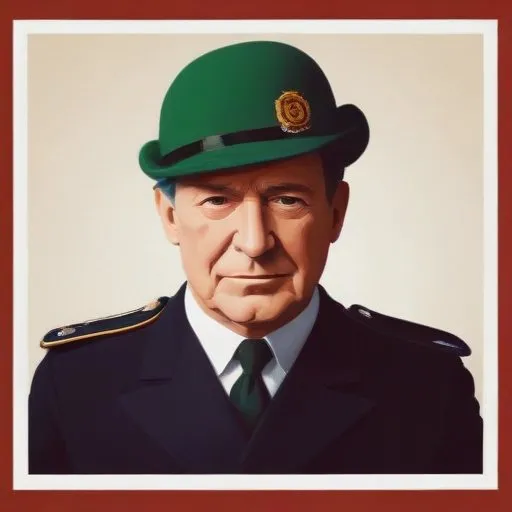
The 4th Prime Minister of Northern Ireland, a Anglo-Irish captain and politician, played a crucial role in shaping the region's politics during a tumultuous period, introducing reforms to address Catholic grievances. He's also known for his efforts to improve relations with the Republic of Ireland.
Terence O'Neill, Baron O'Neill of the Maine, is best known for his transformative leadership as the 4th Prime Minister of Northern Ireland from 1963 to 1969, a tenure marked by unprecedented reform and modernization efforts. O'Neill's courageous attempts to reconcile Ulster unionism with Irish nationalism earned him both admiration and vilification, cementing his place as a complex and fascinating figure in Irish history.
Terence O'Neill was born on September 10, 1914, in London, England, to a family of Anglo-Irish descent. After graduating from Eton College and serving in the British Army during World War II, O'Neill entered politics in 1946 as a member of the Parliament of Northern Ireland.
O'Neill's meteoric rise to prominence began in 1956 when he became Minister of Home Affairs, followed by appointments as Minister of Finance (1958-1963) and Prime Minister of Northern Ireland (1963-1969). His premiership was marked by a series of bold reforms aimed at addressing the province's social, economic, and religious divisions.
O'Neill's political philosophy was rooted in a desire to reconcile Ulster unionism with Irish nationalism, recognizing the need for compromise and cooperation. He believed in the importance of economic development, social justice, and religious tolerance, envisioning a more inclusive and harmonious Northern Ireland.
O'Neill's reform efforts sparked controversy and resistance from both Protestant and Catholic extremist groups, who saw his initiatives as threats to their respective interests. His leadership was also criticized for being out of touch with the needs and aspirations of working-class unionists.
O'Neill's premiership played a crucial role in shaping the trajectory of Northern Ireland's troubled history, laying the groundwork for later peace initiatives and power-sharing agreements. His efforts to address discrimination and promote reconciliation helped pave the way for the Good Friday Agreement (1998).
In 1944, O'Neill married Katharine Jean Whitaker, with whom he had two sons. He was created Baron O'Neill of the Maine in 1970, following his retirement from politics.
O'Neill's legacy extends beyond Northern Ireland, influencing the broader discourse on conflict resolution, power-sharing, and reconciliation worldwide. His commitment to social justice, human rights, and dialogue has inspired generations of politicians and policymakers.
Sir Terence O'Neill, Baron O'Neill of the Maine, may have faced criticism and opposition during his lifetime, but his courageous vision for a more harmonious Northern Ireland has left an indelible mark on Irish history, British politics, and the pursuit of peace and reconciliation worldwide.
Born in 1916
The Prime Minister who led the UK into the European Economic Community (EEC) and navigated the country through a period of economic and industrial turmoil. He's also known for his diplomatic efforts, particularly in regards to the Cold War.
Born in 1903
A British aristocrat who served as Prime Minister from 1963 to 1964, known for his brief tenure and aristocratic background.
Born in 1885
Won the 1952 Olympic Games marathon in Helsinki, Finland, and held the world record in the marathon from 1952 to 1953.
Born in 1917
A former footballer who became the 5th Taoiseach of Ireland, leading the country through a tumultuous period in the late 1960s and early 1970s. He's known for his role in shaping Ireland's modern identity.
Born in 1926
A firebrand Protestant leader who played a key role in Northern Ireland's turbulent politics, known for his strong anti-Catholic stance and later, his surprising shift towards power-sharing.
Born in 1926
A Northern Irish politician who played a key role in the country's civil rights movement and was a founder of the Social Democratic and Labour Party, advocating for peaceful reform.
