


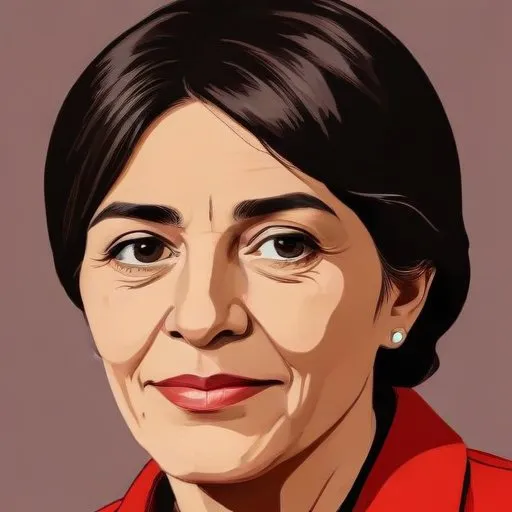
An Italian labor leader, activist, and journalist who fought for workers' rights, women's suffrage, and social justice, leaving a lasting impact on Italy's labor movement.
Teresa Noce was a stalwart Italian labor leader, activist, journalist, and feminist who dedicated her life to advocating for the rights of the working class and women. As a pioneering figure in the Italian Communist Party, she left an indelible mark on the country's social and political landscape, championing broad social legislation that benefited mothers and workers alike.
Born on July 29, 1900, in Turin, Italy, to an unmarried, working-class mother, Teresa's early life was marked by hardship and struggle. She began working as a turner in a local factory at the tender age of 10 and soon found herself involved in the workers' union, participating in demonstrations by the age of 12.
As a journalist, Teresa wrote for Il Grido del Popolo (The People's Cry) and Ordine Nuove from 1914 to 1917, using her platform to voice her concerns about social injustices. She protested Italy's entry into World War I in 1915 and joined the Young Socialist movement in 1919, solidifying her commitment to the cause of the working class.
With the rise of Mussolini and the Fascists, Teresa left the Socialists, becoming a founding member of the Italian Communist Party (PCI) in 1921. As the Communist and Socialist parties were outlawed in 1925, she continued to organize workers illegally, leading the Communist Youth Federation and editing their periodical La voce della gioventù (The Voice of Youth).
In 1926, Teresa married PCI functionary Luigi Longo, and the couple emigrated first to Moscow and then to Paris. She continued to organize workers, including leading a strike of rice workers in 1934, and editing the antifascist periodical La voce della donna (The Voice of Women). During her time in Paris, she also led a campaign on behalf of imprisoned PCI leader Antonio Gramsci, resulting in mass demonstrations.
In 1936, Teresa traveled to Spain to witness the Spanish Civil War, penning several pamphlets that reported on and appealed on behalf of the Spanish Republicans. Following France's surrender to Nazi Germany in 1940, she remained in Paris, organizing cells among the Italian exile community and continuing her fight against fascism.
Teresa Noce's unwavering commitment to the cause of labor rights, feminism, and social justice has left a lasting impact on Italian history. Through her tireless activism, journalistic pursuits, and leadership within the Italian Communist Party, she improved the lives of countless workers and women, paving the way for future generations of social reformers.
Teresa Noce's life is a testament to the power of courage, conviction, and determination in the face of adversity. Her legacy serves as an inspiration to all those who strive to create a more just and equitable society.
Born in 1893
An Italian politician who played a crucial role in shaping the country's post-WWII government and was a key figure in the Italian Communist Party, known for his efforts to reform the justice system.
Born in 1891
An Italian philosopher and politician who developed the concept of cultural hegemony, arguing that power is maintained through cultural and ideological means, rather than just economic or political control.
Born in 1922
Leader of the Italian Communist Party who implemented a policy of Eurocommunism, seeking to reform the party and distance it from Soviet influence.
77 Years Old
The 76th Prime Minister of Italy, a prominent figure in Italian politics, known for his leadership during a time of significant economic and social change in the country. He's also a journalist and politician who played a key role in shaping Italy's modern political landscape.
