


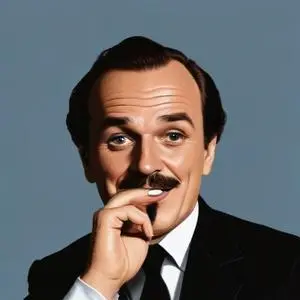
A debonair English comedian and character actor, known for his charming, upper-class persona and memorable roles in classic films like "Private's Progress" and "I'm All Right Jack".
Terry-Thomas was a renowned English character actor and comedian, best known for his iconic portrayals of disreputable members of the upper classes, often playing cads, toffs, and bounders with his distinctive voice, impeccable costume, and props.
His unique persona, complete with a signature monocle, waistcoat, and cigarette holder, was instantly recognizable, and his striking dress sense was further accentuated by the 13-inch gap between his two upper front teeth.
Born Thomas Terry Hoar Stevens on July 10, 1911, in London, Terry-Thomas made his film debut in an uncredited role in The Private Life of Henry VIII in 1933.
He spent several years appearing in smaller roles before serving with Entertainments National Service Association (ENSA) and Stars in Battledress during World War II.
This experience helped sharpen his cabaret and revue act, increased his public profile, and proved instrumental in the development of his successful comic stage routine.
On his demobilization, Terry-Thomas starred in Piccadilly Hayride on the London stage and went on to become the star of the first comedy series on British television, How Do You View, in 1949.
He appeared on various BBC Radio shows, and made a successful transition into British films, with his most creative period being the 1950s.
During this time, he appeared in a string of memorable films, including Privates Progress (1956), The Green Man (1956), Blue Murder at St Trinians (1957), I'm All Right Jack (1959), and Carlton-Browne of the F.O. (1959).
From the early 1960s, Terry-Thomas began appearing in American films, coarsening his already unsubtle screen character in films such as Bachelor Flat (1962), It's a Mad, Mad, Mad, Mad World (1963), and How to Murder Your Wife (1965).
He also frequently starred in European films, taking on roles such as Sir Reginald in the successful French film La Grande Vadrouille.
In 1971, Terry-Thomas was diagnosed with Parkinson's disease, which slowly brought his career to a conclusion. His last film role was in 1980.
He spent much of his fortune on medical treatment and continued to be active in the entertainment industry until his passing on January 8, 1990.
Terry-Thomas's performances often poked fun at the British upper class, using satire to comment on the social norms and values of his time.
His characters, although often pompous and self-important, possessed a certain vulnerability, making them both relatable and endearing to audiences.
Terry-Thomas's unique brand of comedy has influenced generations of comedians and actors, with his irreverent style and mannerisms continuing to inspire new talent.
His performances also helped to shape the public's perception of the British upper class, humanizing them and poking fun at their pretensions.
Terry-Thomas's legacy continues to endure, with his remarkable body of work remaining a testament to his unique talent and inimitable style.
Born in 1924
A pioneering comedian and actor who starred in the iconic BBC sitcom "Hancock's Half Hour," known for his witty humor and lovable loser persona.
Born in 1913
A comedian and entertainer, best known for his charismatic stage presence and starring roles in the Carry On film series.
Born in 1926
A renowned comedic actor and writer, best known for his iconic roles in the Carry On film series and his distinctive voice and wit.
Born in 1922
A beloved comedic actress of British stage and screen, renowned for her larger-than-life personality and iconic roles in the Carry On film series.
79 Years Old
A British pianist and composer, renowned for his iconic jazz scores in 1970s films, including the cult classic "Get Carter". His music blended cool sophistication with gritty realism.
Born in 1925
A beloved British actress, best known for her iconic roles in popular sitcoms, particularly as Nancy in "Absolutely Fabulous" and as Elizabeth in "Terry and June".
94 Years Old
A blonde bombshell and sex symbol of 1950s British cinema, known for her voluptuous figure and provocative on-screen presence.
