


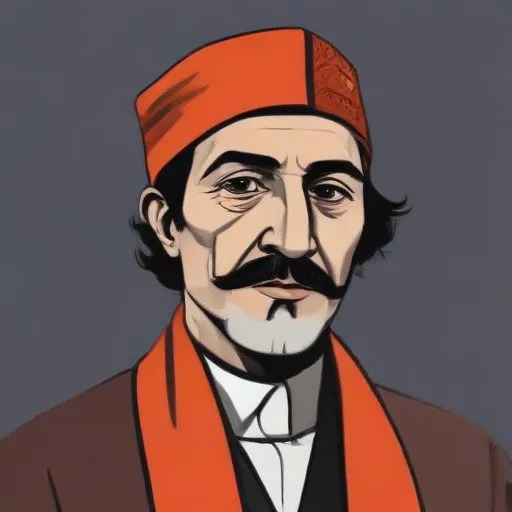
A renowned Turkish poet and educator, known for his romantic and nationalistic poetry that inspired a generation of Turkish writers and intellectuals. His works are still widely read and studied in Turkey today.
Tevfik Fikret, one of the most celebrated Ottoman poets and educators, is credited with laying the foundation of modern Turkish poetry. Born Mehmed Tevfik on December 24, 1867, in Istanbul, Fikret's literary works and educational contributions left an indelible mark on Turkish literature and society.
Fikret's family life was marked by tragedy, with his mother, Hatice Refia Hanm, passing away when he was just a child. His father, Hseyin Efendi, was a political exile, and Fikret's early life was shaped by the absence of his parents. Despite these challenges, Fikret excelled in his education, graduating as the valedictorian from the prestigious Galatasaray High School in 1888.
Fikret's poetry revolutionized Turkish literature, introducing a new style that emphasized simplicity, clarity, and lyricism. His works broke away from the traditional Ottoman poetry, which was heavily influenced by Persian and Arabic styles. Fikret's innovative approach paved the way for future generations of Turkish poets, earning him the title of "founder of modern Turkish poetry."
Fikret's editorial contributions to Serveti Fnun (The Wealth of Knowledge) magazine, which aimed to simplify the Ottoman language, helped establish him as a leading literary figure. He worked alongside prominent Ottoman writers, including Halit Ziya Uaklgil, smail Safa, Mehmet Rauf, Samipaazade Sezai, and Hseyin Cahit Yaln. In 1908, Fikret began publishing Tanin, a newspaper that strongly supported the ruling Committee of Union and Progress (CUP). He also contributed to a women's magazine, further expanding his literary influence.
Fikret's literary and educational contributions continue to inspire generations of Turkish writers and scholars. His legacy is celebrated in the form of the Aiyan House, a museum dedicated to his life and works, located on the Robert College campus. The Aiyan House stands as a testament to Fikret's enduring impact on Turkish literature and culture.
Fikret's personal life was marked by tragedy, including the loss of his sister at an early age. He married his cousin Nazime in 1890, and the couple had a son, Haluk, in 1895. Fikret's dedication to education and literature was matched by his charitable efforts, which focused on promoting education and social welfare in Turkey.
Fikret's poetry and literary works reflect his philosophical beliefs, which emphasized the importance of individual freedom, social justice, and the promotion of Turkish culture. His writings continue to inspire generations of Turks, serving as a beacon of hope and resilience.
Fikret's life and works spanned a period of significant social and political change in Ottoman Turkey. His literary contributions helped shape the cultural identity of modern Turkey, making him an integral figure in the country's literary heritage. Today, Fikret's legacy continues to inspire scholars, writers, and poets, cementing his place as one of the most important figures in Turkish literary history.
Tevfik Fikret's remarkable life and literary achievements have left an indelible mark on Turkish literature and culture. His innovative poetry, educational contributions, and philanthropic efforts have inspired generations, solidifying his place as one of the most important figures in Turkish literary history.
Born in 1873
A Turkish poet, academic, and politician who played a significant role in shaping the country's literary and political landscape, best known for writing the Turkish national anthem.
Born in 1840
A Turkish journalist, playwright, and activist who championed liberal reforms and Turkish nationalism through his writings, inspiring a generation of Ottoman intellectuals.
Born in 1876
A pioneering figure in Turkish sociology, he's renowned for blending nationalism with Western modernity, shaping Turkey's cultural identity through his poetry and activism.
