


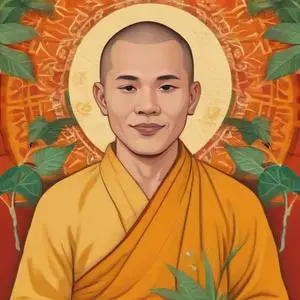
A renowned Vietnamese Buddhist monk, author, and poet who advocated for peace, nonviolence, and mindfulness through his writings and teachings. His works have inspired a global following and influenced Western spirituality.
Thich Nhat Hanh, a renowned Vietnamese Buddhist monk, peace activist, and prolific author, is widely recognized as the father of mindfulness. His teachings and writings have had a profound impact on Western practices of Buddhism, inspiring a new generation of spiritual seekers.
Born Nguyen Xuan Bao on October 11, 1926, in the ancient capital of Hue in central Vietnam, Thich Nhat Hanh was a 15th-generation descendant of the famous poet Nguyen Nha Chi. His early life was marked by a deep sense of compassion and a desire to alleviate suffering, which would become the hallmark of his remarkable career.
In the mid-1960s, Thich Nhat Hanh co-founded the School of Youth for Social Services and established the Order of Interbeing, a community of monastics and laypeople dedicated to actively engaging in social issues. His concept of "engaged Buddhism" emphasized the importance of applying Buddhist principles to real-world problems, earning him international recognition and acclaim.
Thich Nhat Hanh's tireless efforts for peace and nonviolence were recognized globally. In 1967, Martin Luther King Jr. nominated him for the Nobel Peace Prize, a testament to his unwavering commitment to promoting harmony and understanding.
At the core of Thich Nhat Hanh's philosophy was the concept of interconnectedness, which he believed was essential for resolving conflicts and promoting global peace. He advocated for deep listening, compassion, and nonviolence as the keys to resolving conflicts, and his teachings continue to inspire individuals from diverse backgrounds.
In 1966, Thich Nhat Hanh was exiled from South Vietnam for his vocal opposition to the war and his refusal to take sides. After 39 years in exile, he was permitted to return to Vietnam in 2005, where he continued to teach and write until his passing in 2022 at the age of 95.
Thich Nhat Hanh's remarkable legacy extends far beyond his writings and teachings. He established dozens of monasteries and practice centers around the world, including the famous Plum Village Monastery in southwest France. His tireless efforts have inspired countless individuals to adopt a more mindful, compassionate, and peaceful way of living.
In conclusion, Thich Nhat Hanh's remarkable life and teachings have left an indelible mark on modern society. As we reflect on his extraordinary contribution to the world, we are reminded of the transformative power of compassion, nonviolence, and mindfulness.
97 Years Old
A prominent leader in the civil rights movement, advocating for racial equality and social justice through nonviolent means, leaving a lasting impact on American history.
Born in 1869
Indian freedom fighter, activist, and philosopher who led India to independence from British rule through non-violent civil disobedience, inspiring civil rights movements worldwide.
Born in 1872
An Indian spiritual leader who developed a philosophy of integral yoga, aiming to unite spiritual growth with worldly life, and wrote extensively on spirituality, philosophy, and poetry.
95 Years Old
A spiritual teacher and author who wrote about Eastern philosophy and spirituality, helping to popularize meditation and yoga in the West. Known for his book "Be Here Now".
Born in 1926
A leading figure of the Beat Generation, known for his poetry that explores themes of nonconformity, free expression, and social justice. His iconic poem "Howl" is a classic of American literature.
Born in 1922
Pioneering figure of the Beat Generation, known for spontaneous, confessional, and poetic writings that captured the essence of American counterculture in the 1950s and 60s.
Born in 1914
A pioneering figure of the Beat Generation, known for experimental and provocative works that blended fiction and reality, pushing boundaries of literature and art.
96 Years Old
A Beat Generation icon, known for blending spirituality and ecology in poetry and essays that explore humanity's relationship with nature.
