


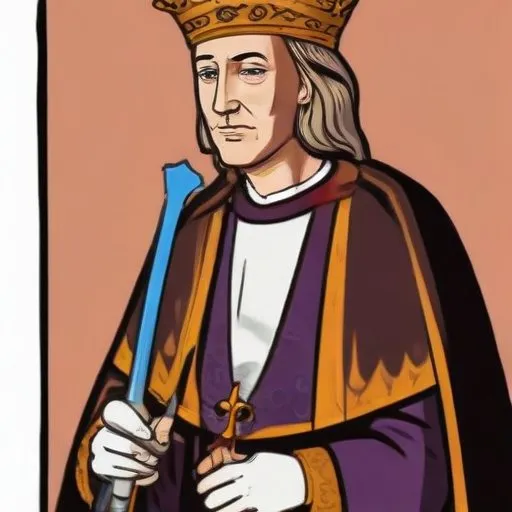
A powerful noble who ruled Champagne and played a key role in the Fourth Crusade, ultimately leading to the disastrous siege of Constantinople. He's infamous for his poor decision-making and tragic consequences.
Theobald III, Count of Champagne, is renowned for his pivotal role in the Third Crusade and his commitment to protecting the rights of the Jewish community in medieval France. As the Count of Champagne from 1197 to his untimely death in 1201, he left an indelible mark on the history of France and the Crusades.
Theobald III was born on May 13, 1179, to Count Henry I of Champagne and Marie of France. He was the younger son, and his older brother, Henry II, was designated as the heir to the county. However, when Henry II embarked on the Third Crusade, Theobald III was named as his successor.
Theobald III married Blanche of Navarre on July 1, 1199, at Chartres, and they had two children: a daughter, Marie, and a son, Theobald IV, who was born posthumously.
Theobald III's reign was marked by his close cooperation with his uncle and suzerain, King Philip II of France. Together, they issued charters in September 1198 to establish the rights of the Jewish community and to settle debts between the king and the count. These charters were reinforced through subsequent agreements between 1198 and 1231.
In 1199, Theobald III hosted a tournament at his castle in Écry-sur-Aisne, where various nobles, including the preacher Fulk of Neuilly, took the cross and pledged to participate in the Fourth Crusade. Theobald III was elected as the leader of the crusade, but sadly, he died before he could embark on the journey.
Theobald III's untimely death on May 24, 1201, led to his widow, Blanche of Navarre, ruling as regent for the next 21 years. During this period, the succession was contested by Theobald III's nieces, Alice and Philippa, daughters of his predecessor, Henry II.
Theobald III was buried beside his father, Henry, at the Church of Saint Stephen in Troyes. His legacy is a testament to his commitment to justice, particularly in his efforts to protect the Jewish community, and his role in shaping the course of the Crusades.
Born in 1387
A medieval queen who ruled Navarre from 1224 to 1274, known for her shrewd diplomacy and strategic marriages that secured her kingdom's independence and prosperity.
Born in 1052
King of France from 1060 to 1108, known for his military campaigns and conflicts with the Church, particularly his excommunication by Pope Urban II.
Born in 1367
The last king of the House of Plantagenet, deposed in a coup, known for his extravagance and tyranny, leading to his downfall and the rise of the Lancastrian dynasty.
Born in 1133
King of England from 1154 to 1189, known for establishing a strong centralized government, reforming the English church, and his tumultuous relationships with Thomas Becket and his sons.
Born in 1785
The last king of the French monarchy before the French Revolution, known for his tragic and mysterious life, including his imprisonment and disputed death.
Born in 1052
King of France from 1060 to 1108, known for his military campaigns and conflicts with the Church, particularly his excommunication by Pope Urban II.
