


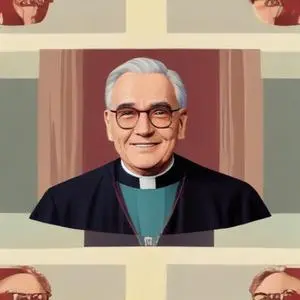
A Catholic priest who served as president of the University of Notre Dame for 35 years, known for his civil rights activism and influential leadership in higher education.
Theodore Hesburgh, a renowned American Catholic priest and academic, is best known for his 35-year tenure as the president of the University of Notre Dame, during which he transformed the institution into a nationally respected hub of higher education. His dedication to education, social activism, and public service earned him numerous honors, including the Presidential Medal of Freedom and the Congressional Gold Medal.
Born on May 25, 1917, in Syracuse, New York, Hesburgh was the second child and oldest son of Theodore Bernard Hesburgh and Anne Murphy Hesburgh. His family's Luxembourgish and Irish roots instilled in him a strong sense of community and social responsibility.
Hesburgh's academic prowess and commitment to service led him to become a member of the Congregation of Holy Cross. He went on to earn multiple degrees, including a Bachelor of Philosophy from Notre Dame and a Doctor of Sacred Theology from the Pontifical Gregorian University in Rome.
Hesburgh's presidency of Notre Dame, which spanned from 1952 to 1987, was marked by significant growth, innovation, and transformation. He oversaw the university's transition to a coeducational institution, expanded its academic programs, and established research centers. Under his leadership, Notre Dame became a major player in American higher education, earning recognition for its academic excellence and research.
Hesburgh's dedication to social justice and human rights led him to participate in various national and international initiatives. He served on the Civil Rights Commission, the National Advisory Council on Education, and the Select Commission on Immigration and Refugee Policy, among others. His commitment to peaceful uses of atomic energy and Third World development earned him recognition from the United States government and the Vatican.
Hesburgh received over 150 honorary degrees, earning him a Guinness World Record. He was also awarded the Presidential Medal of Freedom in 1964 and the Congressional Gold Medal in 2000, in addition to numerous other honors and recognitions.
Theodore Hesburgh's life was a testament to the power of service, leadership, and dedication. His contributions to education, social justice, and public service continue to inspire generations of students, scholars, and community leaders. As a priest, academic, and public servant, Hesburgh left an indelible mark on American society and the global community.
"The Very Rev. Theodore M. Hesburgh, CSC, is a genuine American hero, and his story is an inspiration to anyone who believes in the power of education to change lives and to change the world."
"Education is the key to unlocking the potential of individuals and society. It is the cornerstone of a democratic system, and it is the foundation of a just and peaceful world."
Born in 1917
The 35th President of the United States was a charismatic leader who navigated the country through the Cuban Missile Crisis and advocated for civil rights, leaving a lasting legacy in American politics.
Born in 1908
The 36th President of the United States, a skilled politician and leader, played a crucial role in passing landmark civil rights legislation, including the Civil Rights Act and Voting Rights Act.
Born in 1925
A Navy officer, lawyer, and politician who served as US Attorney General, playing a key role in the Civil Rights Movement and advocating for social justice. He was a prominent figure in American politics during the 1960s.
Born in 1921
A Catholic priest who wrote poetry and protested war and nuclear proliferation through nonviolent civil disobedience, inspiring a generation of activists.
Born in 1923
A Catholic priest who protested the Vietnam War and nuclear proliferation through nonviolent civil disobedience, including burning draft files and hammering on nuclear warhead nose cones.
Born in 1915
A Trappist monk and writer who explored spirituality and social justice through his poetry and essays, leaving a lasting impact on Christian mysticism and contemplative thought.
Born in 1897
A pioneering social activist and journalist who advocated for pacifism, women's rights, and the poor, founding the Catholic Worker Movement to promote social justice and nonviolence.
Born in 1913
The 38th President of the United States, a former football star and lawyer, is known for being the first vice president to assume the presidency under the 25th Amendment and for his controversial pardon of Richard Nixon. He's also remembered for his humble and accidental rise to the presidency.
