


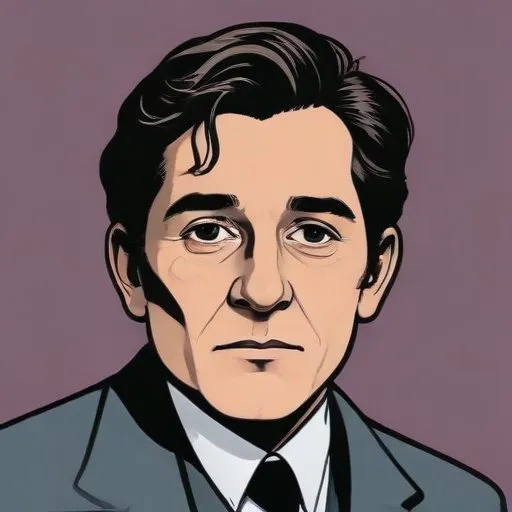
A poet and academic who explored themes of identity, desire, and the human condition through his lyrical and accessible verse, blending traditional forms with modern sensibilities.
Thom Gunn was a celebrated English poet, known for his masterful exploration of the human condition, his philosophical depth, and his unique ability to blend traditional forms with modern sensibilities. His poetry, which spanned over five decades, is characterized by its restrained elegance, precision, and lyricism, earning him a reputation as one of the most respected poets of his generation.
Born on August 29, 1929, in Gravesend, Kent, England, Gunn was the son of journalists Bert Gunn and his wife, who instilled in him a love for reading and literature. His early life was marked by turmoil, with his parents divorcing when he was 10, and his mother's tragic suicide when he was a teenager.
Despite these challenges, Gunn's passion for literature only grew stronger. He attended University College School in Hampstead, London, and later studied English literature at Trinity College, Cambridge, where he graduated with a first-class degree in 1953.
Gunn's first collection of verse, Fighting Terms, was published in 1954 to widespread critical acclaim. His early work was associated with The Movement, a group of British poets who sought to revitalize poetry by emphasizing clarity, simplicity, and directness.
Among his contemporaries, Gunn's poetry was praised for its precision, intellectual rigor, and emotional depth. John Press, a prominent critic, hailed Fighting Terms as "one of the few volumes of postwar verse that all serious readers of poetry need to possess and to study."
In 1954, Gunn emigrated to the United States, where he taught writing at Stanford University and began a new chapter in his life. His move was also motivated by his desire to be with his partner, Mike Kitay, whom he had met while at college.
In America, Gunn's poetry underwent a significant transformation, as he began to experiment with freer, more expressive forms. His subsequent collections, such as The Sense of Movement (1957) and My Sad Captains (1961), showcased his ability to adapt to new surroundings and explore new themes.
Gunn's poetry is characterized by its philosophical depth and nuance. He was deeply interested in exploring the human condition, morality, and the nature of reality.
His poetry often grapples with the tension between individual freedom and social constraint, as well as the relationship between the self and the external world.
Throughout his career, Gunn received numerous literary honors, including the Levinson Prize, the Prix Fénéon, and the Sara Teasdale Memorial Prize.
He was also a fellow of the American Academy of Arts and Sciences and the Royal Society of Literature.
Gunn's legacy extends far beyond his own poetry. He played a significant role in shaping the literary landscape of the 20th century, influencing generations of poets and writers.
His poetry, with its unique blend of traditional forms and modern sensibilities, continues to inspire and challenge readers to this day.
Thom Gunn's life and work are a testament to the power of poetry to illuminate the human experience. His restrained elegance, philosophical depth, and mastery of form continue to inspire and influence poets and readers alike.
99 Years Old
A leading figure of the Beat Generation, known for his poetry that explores themes of nonconformity, free expression, and social justice. His iconic poem "Howl" is a classic of American literature.
Born in 1914
A pioneering figure of the Beat Generation, known for experimental and provocative works that blended fiction and reality, pushing boundaries of literature and art.
Born in 1922
Pioneering figure of the Beat Generation, known for spontaneous, confessional, and poetic writings that captured the essence of American counterculture in the 1950s and 60s.
Born in 1919
A Beat Generation icon who co-founded the legendary City Lights Bookstore, a hub for counterculture and free speech, and penned poetry that captured the spirit of rebellion and nonconformity.
96 Years Old
Beat poet of the 1950s and 60s, known for his spontaneous, conversational style and rebellious, nonconformist spirit. His poetry often explored themes of alienation, social disillusionment, and the search for authenticity.
98 Years Old
A celebrated poet of the New York School, known for his surreal, dreamlike, and often humorous poetry that explores the human condition and the nature of language. His work is characterized by its complexity, wit, and playfulness.
