


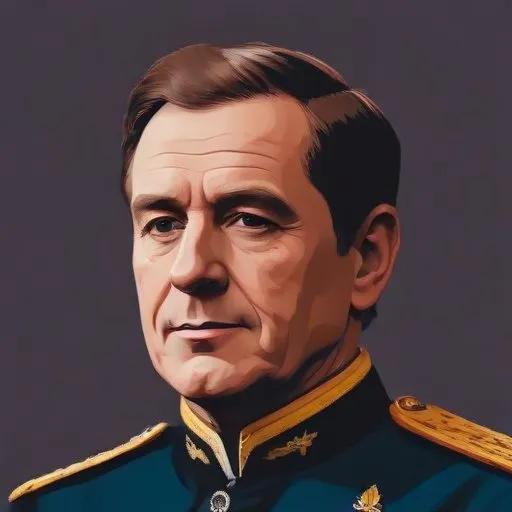
Scottish general and politician who served as the 6th Governor of New South Wales, known for his role in the early development of Australia and the establishment of the New South Wales Supreme Court.
Major General Sir Thomas Makdougall Brisbane, 1st Baronet, is best known for his illustrious military career, his passion for astronomy, and his tenure as the Governor of New South Wales from 1821 to 1825. During his governorship, he encouraged scientific and agricultural training, leaving a lasting legacy in the Australian colony.
Brisbane's military career spanned over three decades, with notable roles in the Flanders, West Indies, Spain, and North America. He served under the revered Duke of Wellington and was promoted to major general in 1813. He saw intense action during the Peninsular War, where he led a brigade in the 3rd Division that broke through at the Battle of Vitoria.
Brisbane's love for astronomy was evident in his endeavors as the Governor of New South Wales. He built the colony's second observatory, further solidifying his reputation as a champion of scientific progress.
In November 1819, Brisbane married Anna Maria Hay Makdougall of Makerstoun, Roxburghshire, Scotland. Upon his father-in-law's death, Brisbane assumed the additional surname Makdougall.
Brisbane's legacy extends far beyond his military and astronomical pursuits. The city of Brisbane, the third largest in Australia, was named in his honor, a testament to his enduring impact on the region.
As a man of science and war, Brisbane's philosophical outlook was shaped by his experiences. His encouragement of scientific and agricultural training in New South Wales reflects his commitment to progress and innovation.
Rivals besmirched Brisbane's reputation, leading to his recall by the British Secretary of State for the Colonies, Lord Bathurst, in 1825. Despite this, Brisbane's achievements and contributions to science, agriculture, and the military remain unparalleled.
Brisbane's life and legacy serve as a testament to the complexities of human endeavor. A decorated military officer, a passionate astronomer, and a champion of progress, his influence on Australian history is indelible.
Brisbane's contemporaries, such as the Duke of Wellington, recognized his exceptional abilities as a military leader. His leadership during the Peninsular War and his role in the Battle of Vitoria established him as a formidable force in the British Army.
Anna Maria Hay Makdougall, Brisbane's wife, was a constant source of support throughout his life. Their union, marked by love and loyalty, stands as a testament to the strength of human relationships.
The Charles C. Platt Homestead, Brisbane's headquarters during the Battle of Plattsburgh, now serves as a museum, preserving the history of the War of 1812.
Major General Sir Thomas Makdougall Brisbane, 1st Baronet, may have lived over two centuries ago, but his legacy continues to inspire and educate generations, a true testament to the power of human achievement.
Born in 1754
A British naval officer who led the infamous HMS Bounty expedition and later governed New South Wales, known for his strict discipline and mutiny-filled voyages.
Born in 1912
Australian war correspondent and novelist who wrote about his experiences in World War II and the Korean War, best known for his novel "My Brother Jack".
Born in 1728
Pioneering surgeon and anatomist who made groundbreaking discoveries in human anatomy, particularly in the field of venereal diseases, and was a pioneer in scientific surgery.
