


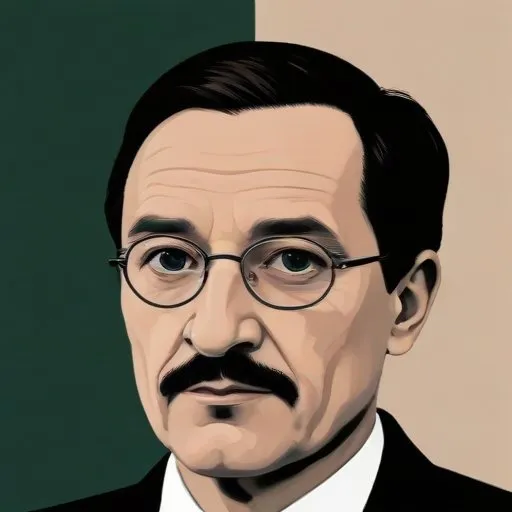
A renowned mathematician and academic who made significant contributions to combinatorics, graph theory, and geometry, shaping the field of mathematics with his innovative ideas.
Tibor Szele was a renowned Hungarian mathematician who made significant contributions to the field of combinatorics and abstract algebra. He is best known for his work on the theory of Abelian groups and ring theory, and is credited with founding the Hungarian school of algebra.
Szele was born on June 21, 1918, in Debrecen, Hungary. He pursued his higher education at the Debrecen University, where he graduated and later became a researcher at the Szeged University in 1946. Two years later, he returned to the Debrecen University, where he eventually became a full professor in 1952.
Szele's work in mathematics was marked by several significant contributions. One of his most notable achievements was the generalization of Hajos' theorem. His research in ring theory and the theory of Abelian groups led to the development of new theories and theorems that have had a lasting impact on the field of mathematics.
In recognition of his outstanding contributions to mathematics, Szele was awarded the prestigious Kossuth Prize in 1952. This award is one of the highest honors in Hungary, and it acknowledged Szele's significant impact on the field of mathematics.
Tibor Szele's legacy extends beyond his mathematical contributions. He founded the Hungarian school of algebra, which has produced many talented mathematicians who have continued to contribute to the field. His work has inspired generations of mathematicians, and his theories and theorems continue to be studied and applied in various fields.
Szele's life was cut short when he passed away on April 5, 1955, in Szeged, Hungary. Despite his untimely death, his contributions to mathematics continue to be celebrated and recognized.
Szele's remarkable contributions to mathematics have left an indelible mark on the field. His work continues to inspire and influence mathematicians, and his legacy will be remembered for generations to come.
Born in 1913
A prolific mathematician who traveled the world, collaborating with others to solve problems and create new theories, producing over 1,500 papers and inspiring a new generation of mathematicians. Known for his eccentric personality and love of coffee.
Born in 1917
A renowned mathematician who made significant contributions to number theory, particularly in the development of the Selberg trace formula, and was awarded the Fields Medal and the Abel Prize.
Born in 1906
A French mathematician and academic who made significant contributions to number theory, algebraic geometry, and the development of modern mathematics, leaving a lasting impact on the field.
Born in 1898
A pioneer in algebraic number theory, he developed the Artin reciprocity law, a fundamental concept in modern number theory. His work has far-reaching implications for cryptography and coding theory.
Born in 1917
A renowned mathematician who made significant contributions to number theory, particularly in the development of the Selberg trace formula, and was awarded the Fields Medal and the Abel Prize.
86 Years Old
A renowned mathematician and computer scientist who made significant contributions to combinatorics, number theory, and theoretical computer science, earning him the Abel Prize in 2012.
