


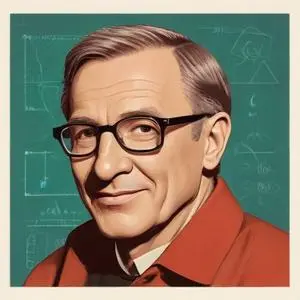
A renowned mathematician and computer scientist who made significant contributions to combinatorics, number theory, and theoretical computer science, earning him the Abel Prize in 2012.
Endre Szemerédi is a Hungarian-American mathematician and computer scientist renowned for his groundbreaking contributions to combinatorics and theoretical computer science. He is particularly celebrated for his proof of the long-standing conjecture of Paul Erdős and Atle Selberg, which has far-reaching implications for number theory and discrete mathematics.
Szemerédi was born on August 21, 1940, in Budapest, Hungary. Initially, he enrolled in a college of medicine due to his parents' wishes, but soon dropped out, realizing that he couldn't handle the immense responsibility. He then pursued his passion for mathematics at the Faculty of Sciences of the Eötvös Loránd University in Budapest, eventually earning his PhD from Moscow State University under the guidance of Israel Gelfand.
Szemerédi has held prestigious positions at various institutions, including Rutgers University, Stanford University, McGill University, the University of South Carolina, and the University of Chicago. He has been the State of New Jersey Professor of Computer Science at Rutgers University since 1986 and holds a professor emeritus status at the Alfréd Rényi Institute of Mathematics of the Hungarian Academy of Sciences.
Among his numerous accolades, Szemerédi was awarded the Abel Prize in 2012 for his fundamental contributions to discrete mathematics and computer science. He has also received the Rolf Schock Prize, the Leroy P. Steele Prize, and the Gödel Prize, among others.
Szemerédi's work has led to several seminal theorems, including:
Szemerédi's contributions have far-reaching implications for various areas of mathematics and computer science, including combinatorics, graph theory, number theory, and theoretical computer science. His work continues to inspire researchers and shape the direction of future research in these fields.
In an interview, Szemerédi revealed that he was initially drawn to mathematics due to his fascination with puzzles and brain teasers. He credits his advisor, Israel Gelfand, for instilling in him a deep love for mathematics and encouraging him to pursue his research interests.
Throughout his illustrious career, Szemerédi has remained humble and dedicated to his craft, inspiring generations of mathematicians and computer scientists to follow in his footsteps.
Szemerédi's work has significant implications for various aspects of modern society, including:
As a testament to his enduring legacy, Szemerédi continues to inspire future generations of mathematicians and computer scientists, driving innovation and progress in numerous fields.
Born in 1913
A prolific mathematician who traveled the world, collaborating with others to solve problems and create new theories, producing over 1,500 papers and inspiring a new generation of mathematicians. Known for his eccentric personality and love of coffee.
Born in 1921
Developed the concept of random graphs, making significant contributions to combinatorics, graph theory, and probability theory. His work has far-reaching implications in computer science, biology, and social networks.
Born in 1903
Pioneering mathematician and physicist who developed the concept of the modern computer architecture and made significant contributions to quantum mechanics and game theory. His work laid the foundation for modern computing and artificial intelligence.
Born in 1917
A renowned mathematician who made significant contributions to number theory, particularly in the development of the Selberg trace formula, and was awarded the Fields Medal and the Abel Prize.
Born in 1887
A renowned mathematician and academic who developed influential problem-solving strategies and wrote seminal books on mathematics, making complex concepts accessible to a broad audience.
74 Years Old
Fantastical fiction author and educator, crafting imaginative novels that blend history, mythology, and adventure, winning numerous awards for his unique storytelling style.
