


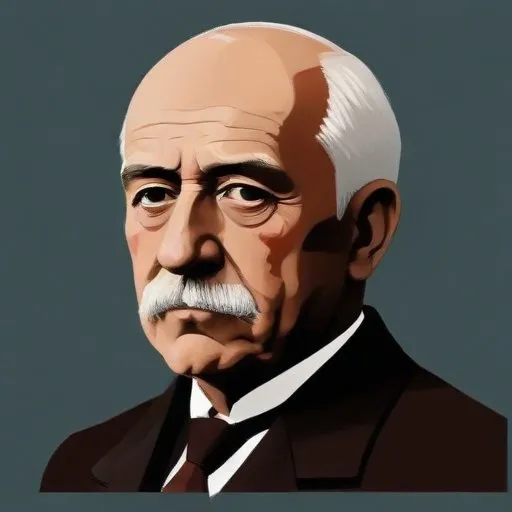
First President of Czechoslovakia, leading the country to independence from Austria-Hungary and establishing a democratic government. He's also known for his sociological works on suicide and nationalism.
Tom Garrigue Masaryk, a Czechoslovakian philosopher, politician, and statesman, is best known for his instrumental role in the creation of Czechoslovakia, a country that ceased to exist in 1993. As the founder and first President of Czechoslovakia, Masaryk's vision for a unified and democratic nation earned him the title of "Father of Czechoslovakia."
Born on March 7, 1850, in Hodonín, Moravia (then part of the Austrian Empire), Masaryk was the second of four children to a Slovak father and a Czech-German mother. His multicultural upbringing instilled in him a deep understanding of the complexities of Central European politics. He pursued higher education in Brno and later in Vienna, where he earned a doctorate in philosophy.
Masaryk's philosophical works focused on humanism, nationalism, and democracy. He believed in the power of education and culture to shape a nation's identity and promoted the idea of a unified Czechoslovak state as a beacon of democracy in Central Europe. His philosophical contributions continue to influence Czech and Slovak thought to this day.
In 1882, Masaryk co-founded the Realist Party, which advocated for Czech autonomy within the Austro-Hungarian Empire.
He served as a professor of philosophy at Charles University in Prague, where he published numerous works on philosophy, politics, and history.
In 1915, he co-founded the Czechoslovak National Council, which aimed to create an independent Czechoslovak state.
On October 28, 1918, Masaryk declared Czechoslovakia's independence, and he was subsequently elected as its first President.
During his presidency, Masaryk implemented democratic reforms, promoted education, and fostered cultural development.
Masaryk's legacy extends far beyond the borders of Czechoslovakia. He inspired democratic movements across Central Europe and played a key role in shaping the post-World War I international order. His commitment to human rights, democracy, and national self-determination continues to influence contemporary politics and international relations.
In 1878, Masaryk married Charlotte Garrigue, an American philanthropist, and adopted her surname as a sign of gratitude.
During World War I, Masaryk traveled extensively, promoting Czechoslovak independence and gathering international support.
He stepped down as President in 1935, citing health reasons, and passed away on September 14, 1937, at the age of 87.
Masaryk's life and work are inextricably linked with the tumultuous history of Central Europe during the late 19th and early 20th centuries. His legacy continues to shape Czech and Slovak identity, and his commitment to democracy and human rights serves as a beacon of inspiration for generations to come.
Masaryk's ideals and actions are often compared to those of other prominent European politicians of his time, such as Woodrow Wilson and Tomáš Švehla. While they shared similar goals and values, Masaryk's unique blend of philosophical and political acumen set him apart as a visionary leader.
| 1850 | Born in Hodonín, Moravia |
| 1882 | Co-founded the Realist Party |
| 1915 | Co-founded the Czechoslovak National Council |
| 1918 | Declared Czechoslovakia's independence and elected as its first President |
| 1935 | Stepped down as President due to health reasons |
| 1937 | Passed away at the age of 87 |
Masaryk was a prolific writer, publishing over 20 books on philosophy, politics, and history.
He was a talented linguist, speaking multiple languages, including Czech, Slovak, German, French, and English.
Masaryk's wife, Charlotte, was an American from Brooklyn, New York, who played a crucial role in promoting Czechoslovakian culture in the United States.
Born in 1856
The 28th President of the United States, a Nobel Peace Prize winner, and a historian who played a key role in shaping international relations and global governance after World War I. He's most known for his idealistic vision of a League of Nations and his efforts to promote peace and diplomacy.
95 Years Old
The last leader of the Soviet Union, who introduced reforms that led to the end of the Cold War and the collapse of communism, earning a Nobel Peace Prize. He's known for his policies of glasnost and perestroika, which transformed the Soviet Union and the world.
Born in 1896
Leader of the Communist Party of Czechoslovakia who oversaw the country's transition to a socialist state and served as president from 1948 to 1953. He's known for his role in establishing a Soviet-backed government in Czechoslovakia.
Born in 1880
A Slovak astronomer, general, and politician who made significant contributions to the development of astronomy in Slovakia and served as a general in the Czechoslovak Legion during World War I. He's also known for being one of the founders of Czechoslovakia.
