


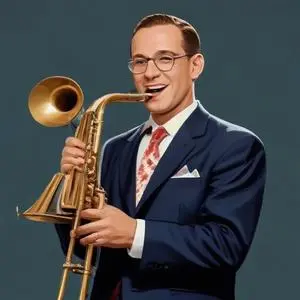
A legendary trombonist, composer, and bandleader of the Big Band era, known for his smooth, melodic style and iconic hits like "I'll Never Smile Again" and "Opus No. 1".
Tommy Dorsey, the American jazz trombonist, composer, conductor, and bandleader, is best known for his smooth-toned trombone playing and his iconic theme song "I'm Getting Sentimental Over You." With a career spanning over three decades, Dorsey was a dominant force in the big band era, earning him the nickname "The Sentimental Gentleman of Swing."
Born on November 19, 1905, in Mahanoy Plane, Pennsylvania, Tommy Dorsey was the second of four children to Thomas Francis Dorsey Sr., a bandleader, and Theresa Langton Dorsey. Alongside his older brother Jimmy, the two became known as the Dorsey Brothers, with Tommy studying trumpet with his father before switching to trombone.
At age 15, Jimmy recommended Tommy to replace Russ Morgan in the Scranton Sirens, a territory band in the 1920s. The brothers worked in bands led by Tal Henry, Rudy Vallee, Vincent Lopez, and Nathaniel Shilkret. In 1923, Dorsey followed Jimmy to Detroit to play in Jean Goldkette's band and returned to New York in 1925 to play with the California Ramblers.
In 1927, Dorsey joined Paul Whiteman, and in 1929, the Dorsey Brothers had their first hit with "Coquette" for OKeh Records. The brothers' band signed with Decca in 1934, having a hit with "I Believe in Miracles." This period also saw Glenn Miller as a member of the Dorsey Brothers Orchestra, composing and recording several tracks.
Tommy Dorsey's technical skill on the trombone earned him renown among other musicians. His smooth, melodic playing style and ability to convey deep emotion through his music made him a standout performer. Some of his most famous hits include "Opus One," "Song of India," "Marie," "On Treasure Island," and his biggest hit single, "I'll Never Smile Again."
Throughout his career, Dorsey received numerous awards and accolades, including multiple Grammy nominations and inductions into the Grammy Hall of Fame. He was also posthumously inducted into the Big Band and Jazz Hall of Fame.
Tommy Dorsey's legacy extends beyond his music, with his impact on the big band era and jazz genre as a whole. He is remembered as one of the greatest trombonists of all time, and his music continues to inspire and influence new generations of musicians.
Tommy Dorsey's personal life was marked by controversy, including a highly publicized feud with his brother Jimmy. Their rift was so severe that the two brothers did not speak for over 10 years. Despite this, they eventually reconciled, and Jimmy even joined Tommy's band for a brief period in the 1950s.
Dorsey was also known for his fiery personality and tantrums, which often led to conflicts with his band members and fellow musicians.
In the 1950s, Dorsey's popularity began to wane, and he turned to television, hosting "Stage Show" with his brother Jimmy from 1954 to 1956. On November 26, 1956, Tommy Dorsey passed away in his sleep, leaving behind a legacy that continues to be celebrated to this day.
At the height of his career, Tommy Dorsey's net worth was estimated to be around $5 million, equivalent to over $50 million today. His music and performances contributed significantly to the growth and popularity of the big band era, generating millions of dollars in revenue and income for himself and fellow musicians.
Tommy Dorsey's impact on modern society extends beyond the music world. His smooth, sentimental style influenced the development of popular music, paving the way for future genres such as easy listening and adult contemporary. His music has been featured in numerous films, television shows, and commercials, ensuring his legacy continues to be felt to this day.
Born in 1904
A renowned saxophonist, composer, and bandleader of the Big Band era, known for his smooth, melodic sound and hit songs like "I'll Never Smile Again" and "Green Eyes".
Born in 1904
A legendary trombonist, composer, and bandleader who led one of the most popular big bands of the 1930s and 1940s, creating iconic hits like "In the Mood" and "Moonlight Serenade".
Born in 1909
A virtuosic clarinetist and bandleader, known as the "King of Swing," who revolutionized jazz music with his energetic and sophisticated style, leading a racially integrated orchestra in the 1930s.
Born in 1910
A virtuosic clarinetist and innovative bandleader, he revolutionized the swing era with his unique sound and iconic hits like "Begin the Beguine" and "Stardust".
Born in 1904
A legendary jazz pianist and bandleader who led a iconic orchestra, blending swing and blues to create a unique sound that influenced generations of musicians. Known for his distinctive "less-is-more" style and hits like "April in Paris" and "One O'Clock Jump".
Born in 1899
A legendary jazz pianist, composer, and bandleader who revolutionized the genre with his unique style and iconic compositions, such as "Take the A Train" and "Mood Indigo".
Born in 1913
A legendary jazz musician and bandleader, known for his virtuosic saxophone and clarinet playing, and leading his iconic orchestra through the swing and bebop eras.
Born in 1916
A legendary trumpet virtuoso and charismatic bandleader, known for his technical brilliance and romantic ballads, as well as his film appearances alongside iconic stars like Betty Grable.
