


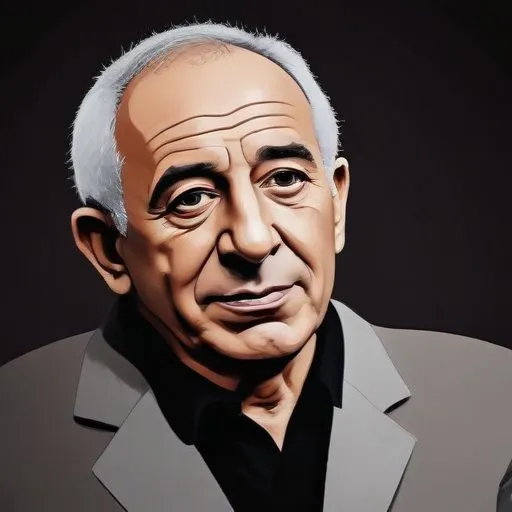
A pioneering Marxist writer and activist, known for his influential works on Leninism and Trotskyism, and his role in shaping the British socialist movement.
Tony Cliff, born Yigael Glckstein, was a prominent Trotskyist activist, writer, and founder of the Socialist Workers Party, a British political organization that played a significant role in shaping the country's socialist movement. Throughout his life, Cliff was known for his unrelenting commitment to socialist ideals and his tireless efforts to unite workers and inspire radical change.
Cliff was born on May 20, 1917, in Zikhron Yaakov, Ottoman Palestine (now Israel), to a Jewish family of Polish immigrants. Growing up in a family deeply rooted in Zionist ideals, Cliff was exposed to influential figures such as Moshe Sharett, who would later become the Prime Minister of Israel. His early life was shaped by his family's strong socialist leanings, which would eventually lead him to adopt Trotskyist ideology.
In 1947, Cliff moved to Britain, where he would begin his journey as a prominent socialist activist. By the late 1950s, he had assumed the pen name Tony Cliff and co-founded the Socialist Review Group, which would later evolve into the International Socialists and eventually the Socialist Workers Party. Cliff's charisma, organizational skills, and unwavering dedication to socialist principles earned him a leadership role in all three organizations.
Cliff's writings and teachings emphasized the importance of workers' self-organization, direct action, and the need for a revolutionary transformation of society. He believed that socialism could only be achieved through the collective efforts of workers themselves, rather than relying on bureaucratic state apparatuses. Cliff's philosophical contributions continue to inspire socialist activists and thinkers to this day.
In 1977, Cliff played a pivotal role in the formation of the Socialist Workers Party, which would go on to become a significant force in British politics. Throughout his life, he faced numerous challenges, including persecution and repression, but remained resolute in his commitment to socialist ideals.
Tony Cliff's legacy extends far beyond his own lifetime. His ideas and activism have inspired generations of socialist activists, trade unionists, and community organizers. His emphasis on workers' self-organization and direct action has influenced movements from the UK to South Africa, and his writings continue to be studied and debated by socialists around the world.
Cliff wrote extensively on socialist theory and practice, producing works such as "Lenin: Building the Party" and "Trotsky: The Darker Side of Genius." His writings and speeches continue to be celebrated for their clarity, passion, and insight into the complexities of socialist politics.
Throughout his life, Cliff faced criticism and controversy, particularly from within the socialist movement itself. Some accused him of dogmatic adherence to Trotskyist ideology, while others saw him as a vital force for radical change. Despite these criticisms, Cliff remained unapologetically committed to his beliefs, earning him both admiration and respect from his peers.
"The working class is the only class that can lead the revolution... because it is the only class that has nothing to lose and everything to gain."
Tony Cliff's life and work must be understood within the context of the tumultuous 20th century, marked by world wars, colonialism, and the rise of socialist and nationalist movements. His legacy serves as a testament to the power of grassroots activism, workers' self-organization, and the unrelenting pursuit of socialist ideals.
82 Years Old
A Pakistani-British historian and novelist who writes about politics, history, and culture, known for his left-wing views and critiques of imperialism and capitalism.
Born in 1887
American journalist and poet who reported on the Mexican Revolution and wrote about the Bolshevik Revolution, known for his eyewitness accounts and poetic writings.
97 Years Old
A philosopher who challenged modern moral philosophy by arguing that morality is rooted in tradition and community, and that we need to revive the Aristotelian concept of virtues to live a good life.
Born in 1924
A pioneering social historian and activist who reshaped the field of history with his groundbreaking works on the British working class, particularly "The Making of the English Working Class".
