


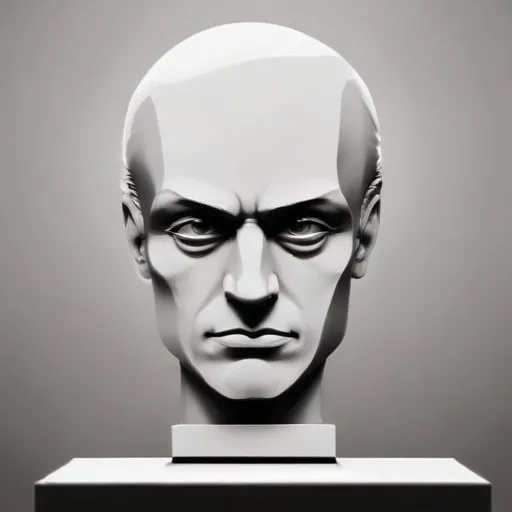
A British artist renowned for his innovative, abstract sculptures that explore the relationship between material, form, and space, often blending organic and industrial elements. His works challenge perceptions and spark curiosity.
Tony Cragg, the renowned Anglo-German sculptor, has been redefining the boundaries of three-dimensional art for over four decades. Known for his innovative use of materials and pioneering approach to sculpture, Cragg's work has captivated audiences worldwide, earning him numerous accolades and cementing his position as one of the most influential artists of our time.
Born on April 9, 1949, in Liverpool, England, Cragg's early life was marked by a strong fascination with art and science. His father, an aerospace engineer, instilled in him a love for precision and craftsmanship, which would later influence his artistic style. After completing his education at the Gloucestershire College of Arts and Technology and the Royal College of Art, London, Cragg embarked on a journey that would take him from laboratory technician to world-renowned sculptor.
Cragg's artistic career began with site-specific installations of found objects and discarded materials. He was drawn to the potential of these everyday items to tell stories and convey emotions. As his style evolved, he began to create assemblages in primary structures, showcasing his unique ability to breathe life into inanimate objects. Works like Stack (1975) and Red Indian (1982-83) exemplify this period, demonstrating Cragg's innovative use of materials and his fascination with the relationship between form and meaning.
In 1977, Cragg relocated to Wuppertal, Germany, a move that would prove pivotal in his artistic development. The city's rich cultural heritage, combined with affordable studio spaces and a receptive art scene, provided the ideal environment for Cragg to flourish. His first solo exhibitions in Germany, including Ltzowstrae Situation in Berlin (1979) and Knstlerhaus Weidenallee in Hamburg (1979), solidified his reputation as a rising star in the art world.
Throughout his illustrious career, Cragg has received numerous awards and honors, including the Turner Prize (1988), the Praemium Imperiale (2007), and the Kunstpreis Nordrhein-Westfalen (2012). His work is held in high esteem by museums and collectors worldwide, with pieces featured in prominent institutions such as the Tate Britain, the Museum of Modern Art, New York, and the Nationalgalerie, Berlin.
Tony Cragg's contributions to the world of sculpture are immeasurable. His innovative approach has inspired generations of artists, from installation pioneers like Rachel Whiteread to contemporary sculptors like Phyllida Barlow. As a master of storytelling through materials, Cragg has expanded our understanding of what sculpture can be, pushing the boundaries of form, meaning, and function. His work continues to captivate audiences, offering a glimpse into the boundless potential of the human imagination.
As we look to the future of sculpture, Tony Cragg's legacy serves as a beacon, illuminating the path for artists to come. His unwavering dedication to innovation, experimentation, and excellence has left an indelible mark on the art world, ensuring that his work will remain a source of inspiration for generations to come.
Born in 1898
A pioneer of modern sculpture, creating abstract, biomorphic forms that evoke a sense of primal emotion, and illustrating books with whimsical, dreamlike drawings.
Born in 1903
A pioneering modernist sculptor, creating abstract, biomorphic forms that explore the relationship between nature and the human experience. Her works often feature smooth, curved surfaces and holes, symbolizing a connection to the natural world.
Born in 1894
A pioneer of abstract art, he's renowned for his geometric, minimalist paintings and sculptures that blend simplicity with profound emotional depth.
Born in 1890
A pioneer of Constructivist art, creating innovative sculptures that explored space, material, and form, pushing the boundaries of modern art.
Born in 1924
A pioneer of modern sculpture, known for creating large-scale, abstract works that explore form, texture, and space. His innovative approach transformed the medium, pushing boundaries and inspiring generations of artists.
90 Years Old
A pioneering artist who blurred the lines between sculpture, painting, and drawing, creating innovative and emotive works that explored the human experience.
86 Years Old
A pioneering figure in modern sculpture, known for large-scale, site-specific installations that challenge viewers' perceptions of space and materiality.
97 Years Old
A Swedish-American artist who created large-scale sculptures of everyday objects, often with a playful and humorous twist, blurring the line between art and reality.
