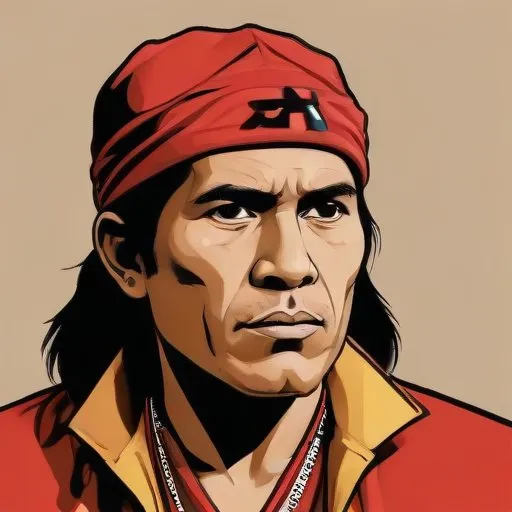
Tupaq Amaru II: The Indigenous Leader Who Defied the Spanish Empire
A Champion of Andean Independence
Tupaq Amaru II, born Jos Gabriel Condorcanqui Noguera, is renowned for leading a massive Andean rebellion against the Spanish Empire in Peru, proclaiming himself the Sapa Inca of a new Inca Empire. This bold move sparked a wave of resistance against Spanish colonial rule, cementing his status as a legendary figure in the Peruvian struggle for independence and indigenous rights.
Early Life and Education
Born around 1742 in Surimana, Tungasuca, in the province of Cusco, Tupaq Amaru II was baptized on May 1 by Santiago
José López in a local church. His childhood was marked by community functions, temple visits, and processions, accompanied by his father, Miguel Condorcanqui Usquionsa, a kuraka of three towns in the Tinta district. After his parents' untimely death at the age of 12, he was raised by his aunt and uncle.
At 16, Tupaq Amaru II received a Jesuit education at the San Francisco de Borja School, where he was instilled with a sense of his social standing as a future kuraka and a member of the royal Inca bloodline.
Rise to Prominence
When Tupaq Amaru II turned 22, he married Micaela Bastidas and succeeded his father as kuraka, granting him rights to land and positioning him as a regional merchant and muleteer. His inherited 350 mules and extensive regional trading networks gave him valuable connections with other indigenous communities and insight into economic conditions.
The Rebellion of 1780-1781
Using his knowledge and influence, Tupaq Amaru II orchestrated a massive rebellion against the Spanish Empire, mobilizing thousands of indigenous people and mestizos. The uprising, though ultimately unsuccessful, sent shockwaves throughout the empire and solidified his status as a champion of Andean independence.
Legacy and Cultural Significance
Tupaq Amaru II's defiance has inspired countless causes in Spanish America and beyond, transcending his time and place in history. He remains an iconic figure in the Peruvian struggle for independence and indigenous rights, symbolizing resistance against colonial oppression.
Trivial Pursuits
- Tupaq Amaru II spoke Quechua, Spanish, and Latin, showcasing his linguistic versatility.
- He was recognized as an elite Quechua from a kuraka family, having attended a school in Cuzco for sons of indigenous leaders.
Philosophical Contributions and Beliefs
Tupaq Amaru II's rebellion was rooted in his conviction that indigenous people deserved autonomy and self-governance. He envisioned a new Inca Empire, free from Spanish domination, where Andean people could reclaim their cultural heritage and territorial sovereignty.
Personal Milestones and Key Life Events
- 1742: Born in Surimana, Tungasuca, in the province of Cusco
- 1754: Baptized on May 1 by Santiago José López
- 1754: Parents' death; raised by aunt and uncle
- 1758: Received Jesuit education at San Francisco de Borja School
- 1764: Married Micaela Bastidas and succeeded his father as kuraka
- 1780-1781: Led the rebellion against the Spanish Empire
- May 18, 1781: Captured and executed by the Spanish
Controversies and Public Perception
Tupaq Amaru II's rebellion, though hailed by many as a heroic act of resistance, was also viewed by some as a violent uprising that ultimately failed to achieve its goals. This dichotomy has contributed to the complexities surrounding his public image, with some perceiving him as a martyr and others as a radical.
Influence on Modern Society
Tupaq Amaru II's legacy continues to inspire social and political movements in Peru and beyond, solidifying his place as a pioneering figure in the struggle for indigenous rights and independence.
FAQ
What were the main goals of Túpac Amaru IIs rebellion?
Túpac Amaru IIs rebellion, which began in 1780, aimed to overthrow Spanish colonial rule in Peru and establish an independent Inca state, with the goal of restoring indigenous rights and self-governance.
How did Túpac Amaru IIs heritage influence his rebellion?
Túpac Amaru IIs inheritance of the noble title of Túpac Amaru, last Inca Emperor of Peru, influenced his rebellion, as he saw himself as the rightful ruler of an independent Inca state.
What was the significance of Túpac Amaru IIs execution?
Túpac Amaru IIs brutal execution by the Spanish in 1781 marked a decisive turning point in the rebellion, leading to its eventual suppression and the continuation of Spanish colonial rule in Peru.
How did Túpac Amaru IIs rebellion impact indigenous rights?
Túpac Amaru IIs rebellion raised awareness about indigenous rights and the injustices faced by indigenous peoples under Spanish colonial rule, paving the way for future indigenous movements and demands for self-determination.
What is the legacy of Túpac Amaru II in Peruvian history?
Túpac Amaru IIs legacy in Peruvian history is that of a heroic figure who fought for indigenous rights and self-determination, serving as a symbol of resistance against colonialism and oppression.