


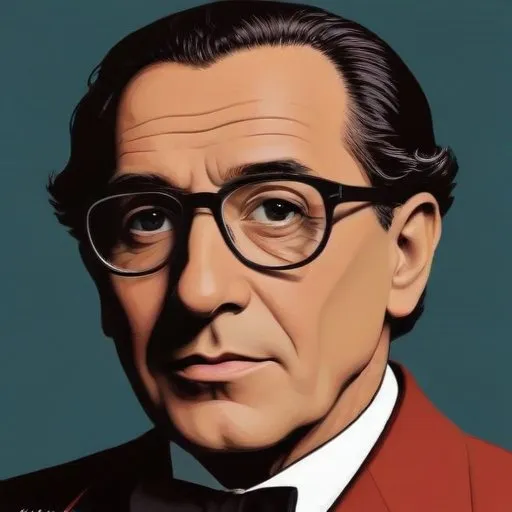
Umberto Giordano, an Italian composer, is renowned for his contributions to the world of opera, particularly in the verismo genre. His most celebrated work, Andrea Chénier, penned in 1896, catapulted him to fame, solidifying his position as a prominent figure in the opera world.
Born on August 28, 1867, in Foggia, Apulia, southern Italy, Giordano's musical journey began under the guidance of Paolo Serrao at the Conservatoire of Naples. This tutelage laid the foundation for his future success, setting him on a path to create works that would leave an indelible mark on the opera world.
Giordano's inaugural opera, Marina, written for a competition promoted by Casa Sonzogno, marked the beginning of Italian verismo. Although it didn't win the competition, it generated enough interest to earn a commission for a full-length opera based on it. The result was Mala Vita, a gritty verismo opera that caused a stir when performed at the Teatro Argentina in Rome in 1892.
Giordano briefly shifted his focus to a more romantic topic with Regina Diaz, a libretto penned by Giovanni Targioni-Tozzetti and Guido Menasci in 1894. Unfortunately, this opera failed to resonate with audiences, receiving only two performances before being taken off the stage.
Giordano's return to verismo with Andrea Chénier in 1896 proved to be a triumphant move, cementing his reputation as a master of the genre. This opera, based on the life of the French poet André Chénier, remains one of his most beloved works. Fedora, written in 1898, further solidified his success, featuring the rising star Enrico Caruso in the lead role.
Although his later works, such as La cena delle beffe, based on a play by Sem Benelli, may not have achieved the same level of success as his earlier masterpieces, they still garner recognition from musicologists and critics. Giordano's legacy as a pioneer of verismo opera continues to inspire and influence future generations of composers and opera enthusiasts alike.
Giordano's contributions to the world of opera extend beyond his own works. His innovative use of verismo, a genre characterized by its focus on everyday life and raw human emotions, paved the way for future generations of composers to experiment with new styles and themes. His influence can be seen in the works of composers such as Puccini and Mascagni, who were inspired by Giordano's bold approach to opera.
Giordano's personal life was marked by significant milestones, including his move to Milan, where he continued to compose works that would leave an indelible mark on the opera world. He passed away on November 12, 1948, at the age of 81, leaving behind a legacy that would continue to inspire and influence generations to come.
The most important theater in Giordano's hometown of Foggia has been dedicated to his honor, a fitting tribute to a composer who left an indelible mark on the world of opera.
Born in 1864
A renowned composer and conductor of the late Romantic era, known for his tone poems and operas that showcased his mastery of orchestration and expressive storytelling.
Born in 1740
An 18th-century Italian composer and educator, known for his operas and contributions to the development of classical music. His works were widely performed and admired by European royalty and aristocracy.
Born in 1797
A renowned Italian composer of the Romantic era, best known for his operas, particularly "L'elisir d'amore" and "Don Pasquale", which are still widely performed today.
Born in 1801
Operatic mastermind behind bel canto classics like "Norma" and "La Sonnambula", renowned for their beautiful, expressive melodies and dramatic flair.
Born in 1811
A virtuosic pianist and composer who revolutionized classical music with his technically demanding and emotionally expressive works, blending Hungarian folk influences with Romantic-era drama.
Born in 1810
A Polish pianist and composer renowned for his delicate, expressive, and technically demanding piano music that evokes deep emotions and continues to inspire generations of musicians and music lovers. His nocturnes, waltzes, and preludes are staples of classical music.
Born in 1678
A virtuosic violinist and prolific composer, he crafted over 400 concertos, including "The Four Seasons," which remains a beloved and iconic masterpiece of classical music.
