


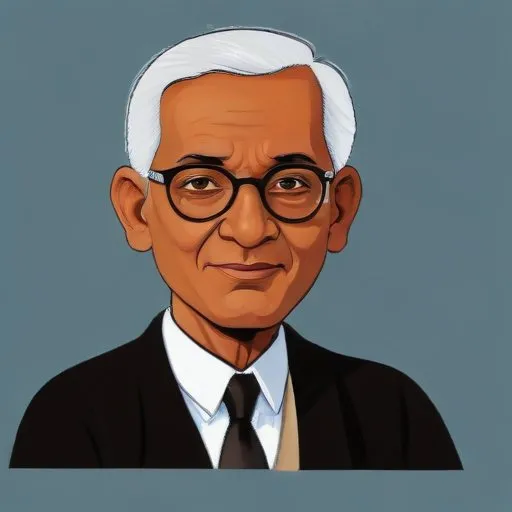
A renowned Indian lawyer and judge who championed social justice and human rights, particularly for the marginalized and oppressed, through his landmark judgments and advocacy.
V. R. Krishna Iyer, the renowned Indian judge, is credited with pioneering the concept of judicial activism, revolutionizing the legal landscape of India. Through his tireless efforts, he championed the cause of the poor and underprivileged, earning him the reputation of being a fearless and passionate advocate for social justice.
Born on November 15, 1914, in Vaidyanathapuram village, Palakkad, Krishna Iyer hailed from a Tamil Brahmin family. His father, Rama Iyer, a lawyer, instilled in him the values of community service and the importance of using the law to benefit the marginalized. Krishna Iyer's educational background includes stints at Basel Evangelical Mission Parsi High School, Thalassery, Government Victoria College, Palakkad, Annamalai University, and Dr. Ambedkar Government Law College, Chennai.
Krishna Iyer was an ardent believer in the power of law as a tool for social change. He championed the cause of human rights, environmental justice, and social equality, often going against the establishment to stand up for what he believed in. His philosophical contributions include:
Krishna Iyer's contributions to the field of law and social justice were recognized with the highest honors, including the Padma Vibhushan in 1999. His legacy continues to inspire and influence the legal fraternity, with his judgments frequently cited in higher courts.
V. R. Krishna Iyer's pioneering work in judicial activism has had a profound impact on modern Indian society. His tireless efforts to promote social justice and human rights have inspired a generation of lawyers, activists, and policymakers. His legacy continues to shape the legal landscape, influencing policy decisions and advocacy efforts.
Krishna Iyer's life is a testament to the power of courage, conviction, and compassion. Despite facing imprisonment and opposition, he remained unwavering in his commitment to social justice, inspiring countless individuals to take up the mantle of advocacy and activism.
His inspiring story serves as a beacon of hope, motivating individuals to stand up for what is right, even in the face of adversity.
Born in 1896
Fourth Prime Minister of India, known for his efforts to decentralize power and promote economic development, and for being the first Indian Prime Minister to resign from office.
Born in 1917
The first female Prime Minister of India, serving from 1966 to 1977 and again from 1980 until her assassination in 1984, known for her strong leadership and economic reforms.
Born in 1884
India's first president, a key figure in the country's struggle for independence, who played a crucial role in shaping the nation's early years. He's revered for his leadership and commitment to democracy.
Born in 1888
An Indian philosopher and politician who served as the 2nd President of India, known for his influential writings on Indian philosophy and his role in shaping India's education system.
Born in 1889
India's first Prime Minister, a key figure in the country's struggle for independence from British rule, and a champion of democracy and secularism. He played a crucial role in shaping modern India's government and economy.
