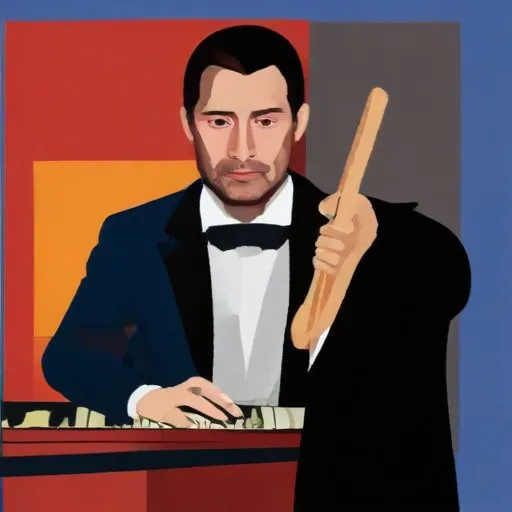
Vadim Salmanov: The Soviet Maestro of Melodic Mastery
A Legacy of Harmony and Patriotism
Vadim Salmanov was a renowned Soviet composer and pedagogue, celebrated for his symphonies, string quartets, and violin concertos that echoed the sentiments of his motherland. With a career spanning over four decades, Salmanov left an indelible mark on the world of classical music, earning him the titles of Honored Artist of the RSFSR in 1962 and People's Artist of the RSFSR in 1972.
The Early Years: A Precursor to Musical Greatness
Born on November 4, 1912, in Saint Petersburg, Salmanov's affinity for music was nurtured by his father, a professional metallurgical engineer who taught him piano from a young age. As he delved into the works of Baroque, Classical, and Romantic masters, Salmanov's passion for music grew, leading him to enroll in music theory courses at the tender age of six. However, following his father's passing, Salmanov took a detour into the realm of hydrogeology, working as a geologist until 1935.
The Call of Music: A Return to Roots
It was a chance encounter with Soviet pianist
Emil Gilels' concert that reignited Salmanov's passion for music, prompting him to enroll in the Leningrad Conservatory. Under the guidance of esteemed composer Mikhail Gnesin, Salmanov honed his craft, eventually graduating and dedicating himself to composition.
War, Patriotic Fervor, and Artistic Expression
With the outbreak of World War II, Salmanov enlisted in the Soviet Army, serving from 1941 to 1945. Upon his return, he resumed his pedagogical work at the Leningrad Conservatory, teaching from 1946 to 1951. This period saw him channel his experiences into his art, setting poems by Russian titans like Blok and Yesenin, as well as Spanish masters
Federico García Lorca and
Pablo Neruda.
Symphonies and String Quartets: A Testament to Craftsmanship
Salmanov's magnum opus, Symphony No. 1 in D minor, penned in 1952, is a masterclass in melodic storytelling. Dedicated to conductor
Yevgeny Mravinsky, the work weaves Slavic folk melodies with a recurring motto theme that resurfaces in the Finale. His subsequent symphonies, including Symphony No. 4, also received critical acclaim. Additionally, Salmanov's oeuvre boasts six string quartets (1945-1971) and two violin concertos (1964, 1974), showcasing his versatility and command over various genres.
A Legacy of Inspiration
As a pedagogue, Salmanov's influence extended beyond his compositions. He taught at the Leningrad Conservatory, nurturing the next generation of musicians and composers. Through his music and mentorship, Salmanov left an indelible mark on Soviet cultural heritage, solidifying his position as one of the most revered figures in Russian classical music.
Awards and Accolades
- Honored Artist of the RSFSR (1962)
- People's Artist of the RSFSR (1972)
FAQ
What was Vadim Salmanovs contribution to Russian music?
Vadim Salmanov was a Russian pianist and composer known for his expressive and nuanced performances, as well as his compositions that blended classical and folk elements.
What was Vadim Salmanovs early life and training?
Vadim Salmanov was born in Leningrad and began studying piano at the age of five, eventually attending the Leningrad Conservatory and studying under prominent Russian composers.
What was Vadim Salmanovs compositional style?
Vadim Salmanovs compositional style was characterized by lyricism, harmony, and a deep connection to Russian folk music, reflecting his love for his native countrys cultural heritage.
How did Vadim Salmanovs music impact Russian culture?
Vadim Salmanovs music helped to promote Russian culture and folk traditions, inspiring a new generation of composers and musicians to explore and celebrate their heritage.
What is Vadim Salmanovs legacy in Russian music?
Vadim Salmanovs legacy in Russian music is one of creativity, innovation, and dedication, leaving a lasting impact on the countrys rich cultural heritage.