


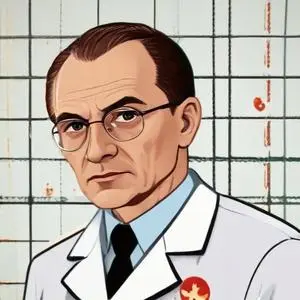
A Soviet inorganic chemist who led the investigation into the catastrophic Chernobyl nuclear disaster, uncovering its causes and consequences. He's known for his courageous pursuit of truth amidst government pressure.
Valery Legasov, a renowned Soviet inorganic chemist, is best known for his heroic efforts in containing the devastating 1986 Chernobyl disaster. As the chief investigator, he presented the findings of the investigation to the International Atomic Energy Agency, detailing the catastrophic events that led to the explosion of Reactor No. 4 at the Chernobyl Nuclear Power Plant.
Born on September 1, 1936, in Tula, Russian SFSR, Legasov came from a family of civil workers. He excelled in both academics and social activities, earning a gold medal upon graduation from School No. 56 in Moscow. His headmaster observed that Legasov was a "grown-up man, a future statesman, a talented organizer" who could excel in various fields, including philosophy, history, and engineering.
In 1961, Legasov graduated from the Faculty of Physicochemical Engineering at the Mendeleev Moscow Institute of Chemistry and Technology, where he gained valuable knowledge on nuclear fuel processing, handling, and disposal.
Legasov's leadership skills and talent for organization led him to become the released secretary of the Central Committee of the Komsomol, followed by his election to the bureau of the Soviet District Committee of the Komsomol and the Moscow City Committee of the Komsomol.
In 1986, Legasov was appointed as the chief investigator of the Chernobyl disaster, tasked with uncovering the causes of the catastrophic event and presenting the findings to the international community.
Legasov's courageous and meticulous investigation revealed the human error and design flaws that led to the disaster. His report, presented at the Vienna conference, provided a thorough analysis of the events leading up to the explosion, including the safety test that went awry and the inadequate safety measures in place.
Legasov's efforts not only shed light on the causes of the disaster but also paved the way for significant improvements in nuclear safety worldwide. His work has been recognized as a crucial contribution to the development of international nuclear safety standards.
Legasov married Margarita Mikhailovna and had two children, Inga Legasova and Aleksey Valeryevich Legasov. He also had two grandchildren, Misha and Valerik.
Throughout his life, Legasov was known for his strong sense of responsibility and commitment to his work. His dedication to the Chernobyl investigation came at a great personal cost, as he suffered from depression and ultimately took his own life on April 27, 1988, two years after the disaster.
Valery Legasov's bravery and expertise in the face of unimaginable disaster have left an indelible mark on the world of science and beyond. His work continues to inspire new generations of scientists, engineers, and policymakers to prioritize safety and responsible innovation.
95 Years Old
The last leader of the Soviet Union, who introduced reforms that led to the end of the Cold War and the collapse of communism, earning a Nobel Peace Prize. He's known for his policies of glasnost and perestroika, which transformed the Soviet Union and the world.
Born in 1921
A Soviet physicist and dissident who advocated for human rights and nuclear disarmament, earning a Nobel Peace Prize in 1975. He's known for his courageous stance against the Soviet regime, promoting peace and democracy.
98 Years Old
A Georgian politician who served as the country's second president, known for his role in ending the Cold War and introducing democratic reforms to Georgia.
88 Years Old
A Russian politician who served as Prime Minister from 1992 to 1998, known for his role in shaping post-Soviet Russia's economy and politics.
