


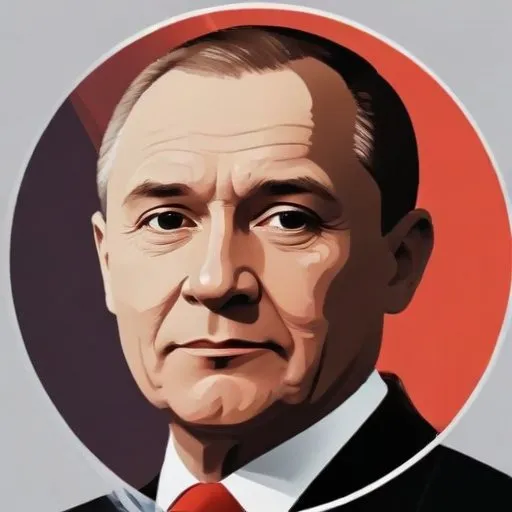
A Russian politician who served as Prime Minister from 1992 to 1998, known for his role in shaping post-Soviet Russia's economy and politics.
Viktor Chernomyrdin is best known for being the second-longest-serving Prime Minister of Russia, holding the position from 1992 to 1998, and his instrumental role in shaping the country's transition from a planned to a market economy. He was also the former Minister of Gas Industry of the Soviet Union and the first chairman of Gazprom energy company.
Chernomyrdin was born on April 9, 1938, in Chernyi Otrog, Orenburg Oblast, Russian SFSR, to a laborer father and was one of five children. He completed his school education in 1957 and found employment as a mechanic in an oil refinery in Orsk, where he worked until 1962, except for his military service from 1957 to 1960.
Chernomyrdin became a member of the Communist Party of the Soviet Union (CPSU) in 1961 and gradually rose through the ranks. He held various positions in the oil industry, including machinist, operator, and chief of technical installations. In 1985, he was appointed as the Minister of Gas Industry of the Soviet Union, a position he held until 1989.
In 1989, Chernomyrdin became the first chairman of Gazprom, a position he held until 1992. During his tenure, he played a crucial role in transforming the company into one of the largest and most influential energy companies in the world. In 1992, he was appointed as the Prime Minister of Russia, a position he held until 1998, making him the second-longest-serving Prime Minister in Russian history.
Chernomyrdin was known for his pragmatism and commitment to economic reform. He believed in the importance of gradually introducing market-oriented reforms to the Russian economy, rather than implementing rapid and radical changes. His approach was often criticized by liberal reformers, who advocated for more rapid and extensive reforms.
Chernomyrdin's legacy is complex and multifaceted. While he is often credited with stabilizing the Russian economy and promoting economic growth, he is also criticized for his role in the country's transition to a market economy, which led to widespread poverty and inequality. However, his commitment to gradual reform and his advocacy for a mixed economy approach have also been praised by many.
Chernomyrdin was known for his unique language style, which often contained malapropisms and syntactic errors. Two of his most famous sayings have become aphorisms in the Russian language: "We wanted the best, but it turned out like always" and "The thing that never happens just happened again."
Chernomyrdin's language style and his often-quoted sayings have become a part of Russian popular culture. He has been the subject of numerous jokes, cartoons, and parodies, and his quotes have been widely used in advertising and media.
Chernomyrdin was awarded the Order of Lenin, the Order of the October Revolution, and the Order of the Red Banner of Labor, among other honors, for his contributions to the Soviet and Russian economies.
Chernomyrdin was involved in various charitable activities, including the support of children's hospitals and orphanages. He was also a strong advocate for education and healthcare reform in Russia.
Chernomyrdin's rise to prominence from humble beginnings is an inspiration to many. His commitment to public service and his dedication to improving the lives of the Russian people are a testament to his character and leadership.
Overall, Viktor Chernomyrdin was a complex and multifaceted figure who played a significant role in shaping Russia's economy and politics. His legacy continues to be felt today, and his contributions to the country's development will be remembered for generations to come.
95 Years Old
First President of Russia, leading the country's transition from communism to democracy, and known for his bold reforms and iconic leadership style.
74 Years Old
A Russian politician who has dominated the country's politics for over two decades, known for his authoritarian leadership style and controversial foreign policy decisions.
95 Years Old
The last leader of the Soviet Union, who introduced reforms that led to the end of the Cold War and the collapse of communism, earning a Nobel Peace Prize. He's known for his policies of glasnost and perestroika, which transformed the Soviet Union and the world.
61 Years Old
Russian lawyer and politician who served as President of Russia from 2008 to 2012, known for his efforts to modernize Russia's economy and politics. He also served as Prime Minister from 2012 to 2020.
96 Years Old
A Ukrainian-Russian journalist and politician who served as Russia's Prime Minister from 1998 to 1999, known for his efforts to stabilize the country's economy and foreign policy during a tumultuous period.
85 Years Old
The 37th Prime Minister of Russia, serving from 2007 to 2008, known for his brief tenure and role in Russian politics during Vladimir Putin's presidency. He's a businessman and politician with ties to the energy sector.
81 Years Old
Russian Minister of Foreign Affairs from 1998 to 2004, known for playing a key role in shaping Russia's foreign policy and international relations during a pivotal period. He was a skilled diplomat who navigated complex global issues.
