


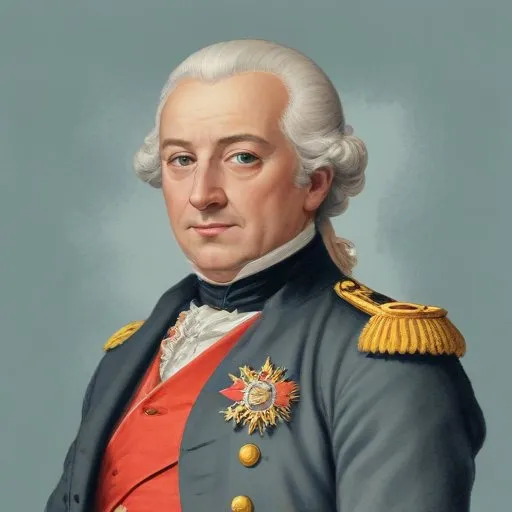
King of Sardinia from 1773 to 1796, known for his military campaigns against the French Revolution and his cultural achievements, including the establishment of the University of Cagliari.
Victor Amadeus III of Sardinia, also known as the Duke of Savoy, was a steadfast leader who dedicated his life to fighting for the independence of his kingdom against the dominance of neighboring European powers. Born on June 26, 1726, in Turin, Italy, he ruled Sardinia from 1773 to 1796, leaving an indelible mark on the history of his kingdom and beyond.
Victor Amadeus III's reign was marked by a series of conflicts with European powers, particularly France and Spain. He was a skilled diplomat and strategist who navigated the complex web of alliances and rivalries between European nations to protect Sardinia's interests. His unwavering commitment to his kingdom earned him the respect and admiration of his people.
In 1792, France, in the midst of its Revolution, declared war on Sardinia, prompting Victor Amadeus III to forge an alliance with Austria, Prussia, and Great Britain. The ensuing conflict, known as the French Revolutionary Wars, lasted for over a decade and saw Sardinia fight bravely against the French occupation.
Victor Amadeus III was born to Charles Emmanuel III, Duke of Savoy, and his wife, Elisabeth Therese of Lorraine. He married Maria Antonia of Spain in 1750, with whom he had 12 children. His eldest son, Charles Emmanuel IV, succeeded him as King of Sardinia.
Victor Amadeus III's legacy extends beyond his military campaigns and diplomatic efforts. He was a patron of the arts and sciences, and his court attracted scholars, writers, and artists from across Europe. He also implemented several reforms aimed at modernizing Sardinia's economy, infrastructure, and education system.
Victor Amadeus III lived during a tumultuous period in European history, marked by the rise of nationalism, the French Revolution, and the subsequent Napoleonic Wars. His determination to defend Sardinia's independence against the dominant powers of the time earned him a place in the annals of history as a hero and a symbol of resistance.
Victor Amadeus III was decorated with several honors and awards, including the Order of the Golden Fleece, the Order of the Annunciation, and the Order of Saints Maurice and Lazarus.
| Year | Event |
|---|---|
| 1726 | Born in Turin, Italy |
| 1750 | Marries Maria Antonia of Spain |
| 1773 | Becomes King of Sardinia |
| 1792 | Declares war on France |
| 1796 | Dies in Turin, Italy |
Victor Amadeus III's life was a testament to his unwavering commitment to his kingdom and his people. His legacy continues to inspire generations, serving as a reminder of the importance of courage, determination, and leadership in the face of adversity.
Born in 1820
Unified Italy's first king, who played a key role in the country's unification and modernization. He's remembered for his strong leadership and diplomatic skills.
Born in 1844
King of Italy from 1878 to 1900, known for unifying Italy and establishing the modern Italian state. He played a key role in Italian politics and foreign policy during his reign.
Born in 1851
The Italian queen consort who reigned from 1878 to 1900, known for her strong support of the Italian unification and her charitable work, especially in the field of education.
Born in 1769
A French military leader who rose to prominence during the French Revolution and became Emperor of France, known for his military conquests and reorganization of Europe. He is also famous for his Napoleonic Code, which remains a foundation of modern law.
