


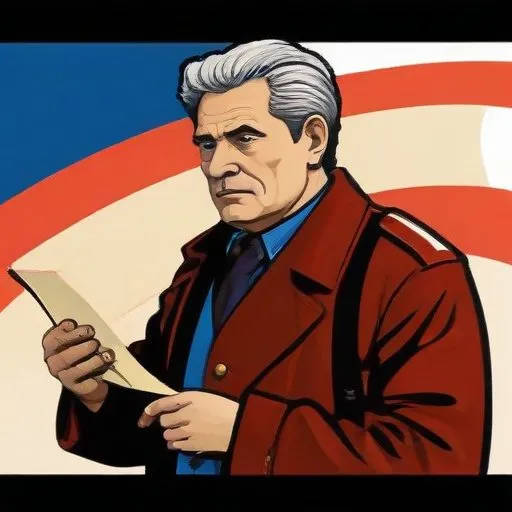
Chronicler of the history of workers and trade unions in Russia, documenting the struggles and achievements of the labor movement. Known for preserving the stories of ordinary people who shaped the country's industrial landscape.
Victor Nosach, a renowned Soviet and Russian historian, is celebrated for his monumental contributions to the field of labor history, particularly in the realm of trade unions in Russia. His tireless efforts in documenting and analyzing the evolution of workers' movements have earned him the reputation as a chronicler of Russian labor history.
Born on December 8, 1929, in Fyodorovka village, Ukraine, Nosach's early life was marked by a sense of service, having served in the Chernomorskiy Fleet in Odessa from 1946 to 1952. He later pursued his academic interests, graduating from Leningrad High Trade Union School of Culture in 1958 and the National University of Kharkiv's Department of History in 1959. His academic pursuits continued with his postgraduate studies at Moscow High School of Trade Unions, which he completed in 1963.
Nosach's academic sojourn saw him author over 25 manuscripts and books, as well as more than 300 scientific articles, focusing on the history of workers and trade unions of Russia. His areas of expertise included cultural and educational activities of trade unions. For an impressive span of over 50 years, he taught at the Saint Petersburg University of Humanities and Social Sciences, nurturing generations of students and scholars.
Nosach's outstanding contributions were recognized through various awards and honors, including the Order of Friendship of Peoples, the Order of Honour of Russia, the Medal For Labour Valour, and the medal for Labor Prowess, among others. These accolades testify to his dedication and commitment to his field of study.
Victor Nosach's legacy extends beyond his academic achievements. He played a pivotal role in shaping the understanding of Russian labor history, providing invaluable insights into the evolution of workers' movements. His work has inspired a new generation of scholars, ensuring the continued relevance of his research in the contemporary landscape.
Nosach's untimely passing on May 7, 2011, in a car accident in Saint Petersburg, was a loss to the academic community. He was laid to rest on Volkovo Cemetery, leaving behind a rich legacy that continues to influence the study of Russian labor history.
These seminal works, among many others, have cemented Nosach's position as a leading authority in the field of Russian labor history.
Victor Nosach's remarkable life and work serve as a testament to his unwavering dedication to the study of Russian labor history. His contributions continue to inspire and inform, ensuring his legacy endures for generations to come.
Born in 1870
Founder of the world's first socialist state, leading the Bolshevik Revolution and establishing the Soviet Union, known for his radical Marxist ideology and authoritarian rule.
Born in 1878
The Soviet Union's ruthless leader who ruled with an iron fist, implementing policies that led to widespread famine and purges, while also playing a crucial role in defeating Nazi Germany in World War II.
95 Years Old
The last leader of the Soviet Union, who introduced reforms that led to the end of the Cold War and the collapse of communism, earning a Nobel Peace Prize. He's known for his policies of glasnost and perestroika, which transformed the Soviet Union and the world.
Born in 1879
Founded the Red Army and played a crucial role in the Russian Revolution, shaping the course of modern communism. A key figure in 20th-century politics and ideology.
Born in 1896
A Soviet military leader who played a crucial role in defeating Nazi Germany in World War II, and later became a key figure in Soviet politics.
Born in 1888
A prominent figure in the Russian Revolution, he was a key architect of the Soviet economy and a vocal critic of Stalin's regime, ultimately falling victim to his purges.
Born in 1896
A high-ranking Soviet politician and ideologue who played a key role in shaping the country's cultural and artistic policies, particularly during the post-WWII era.
Born in 1899
Soviet Union's ruthless secret police chief, responsible for millions of deaths and brutal suppressions during Stalin's regime, known for his cunning and feared reputation.
