


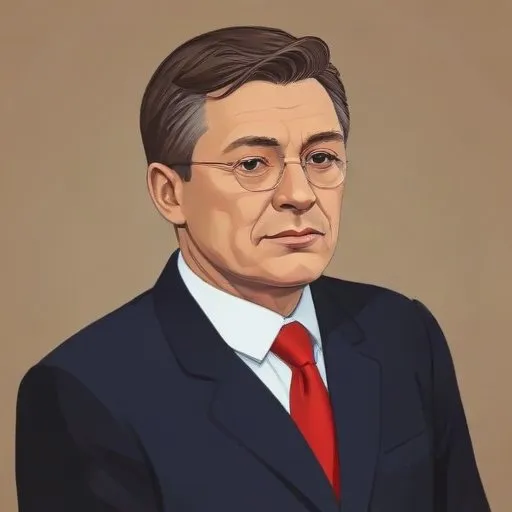
A high-ranking Soviet politician and ideologue who played a key role in shaping the country's cultural and artistic policies, particularly during the post-WWII era.
Andrei Zhdanov was a prominent Soviet politician who played a crucial role in shaping the country's cultural policy after World War II. He is best known for developing the Zhdanov Doctrine, a rigid cultural ideology that dominated the Soviet arts scene until the death of Joseph Stalin.
Zhdanov was born on February 26, 1896, in Mariupol, Ukraine, then part of the Russian Empire. He joined the Bolsheviks in 1915 and rapidly rose through the party ranks. In 1934, he became a secretary of the Central Committee and later that year, he was promoted to Leningrad party chief following the assassination of Sergei Kirov.
Zhdanov's association with Stalin earned him a significant amount of power and influence. In 1939, he was promoted to full membership of the Politburo and became the head of the Central Committee's Propaganda Department. During the Great Purge, he played a major role in perpetuating Stalin's reign of terror.
After World War II, Zhdanov was tasked by Stalin with directing cultural policy. His campaign, known as the Zhdanovshchina, was aimed at promoting socialist realism in the arts and suppressing any form of dissent or nonconformity. The doctrine led to the denouncement of numerous artists, including Anna Akhmatova and Dmitri Shostakovich, who were forced to conform to the regime's strict cultural norms.
Zhdanov's personal life was marked by controversy and tragedy. He suffered from ill health and fell out of favor with Stalin as a result of the Tito-Stalin split. He died of heart failure on August 31, 1948, at the age of 52.
Zhdanov's legacy is complex and multifaceted. While he played a significant role in shaping the Soviet Union's cultural policy, his doctrine also led to the suppression of artistic freedom and the persecution of numerous artists. Despite his flaws, he remains an important figure in Soviet history, a testament to the power and influence of propaganda in shaping a nation's identity.
Zhdanov was known for his rigid ideology and his commitment to promoting socialist realism. One of his most famous quotes is: "The task of our literature is to help the Party to educate our youth in the spirit of bolshevism, to teach them to hate everything that is reactionary, to inspire them with the spirit of struggle and the determination to build socialism."
Born in 1878
The Soviet Union's ruthless leader who ruled with an iron fist, implementing policies that led to widespread famine and purges, while also playing a crucial role in defeating Nazi Germany in World War II.
Born in 1890
A Soviet Minister of Foreign Affairs who played a crucial role in shaping the country's foreign policy during World War II and the early Cold War era, known for his diplomatic skills and signature cocktails.
Born in 1899
Soviet Union's ruthless secret police chief, responsible for millions of deaths and brutal suppressions during Stalin's regime, known for his cunning and feared reputation.
Born in 1879
Founded the Red Army and played a crucial role in the Russian Revolution, shaping the course of modern communism. A key figure in 20th-century politics and ideology.
Born in 1881
A Soviet politician and military leader who served as Defense Minister during World War II, playing a crucial role in the Soviet war effort and later becoming a key figure in Stalin's government. He's also known for his iconic tank, the KV-1, named in his honor.
Born in 1895
A skilled politician who played a crucial role in Soviet politics, serving as the head of state and a close ally to Soviet leaders, including Stalin and Khrushchev. He's known for his adaptability and ability to navigate the treacherous waters of Soviet politics.
