


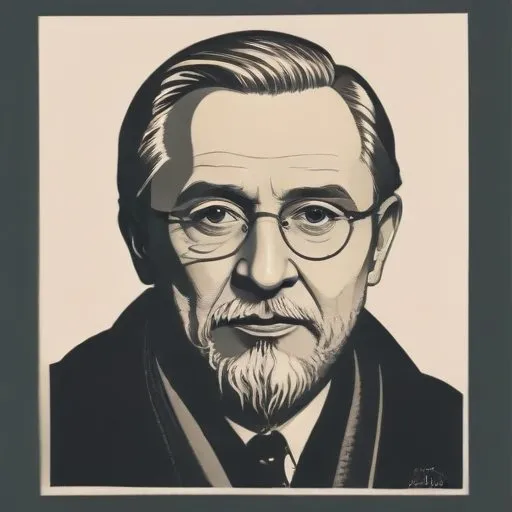
A prominent Russian mathematician and academic, known for his work on number theory, particularly the development of the Brunyakovsky theorem, a fundamental concept in modern mathematics.
Viktor Yakovlevich Bunyakovsky, a Russian mathematician, is renowned for his groundbreaking contributions to theoretical mechanics and number theory, earning him a prominent place in the annals of mathematical history. His most notable achievements include the formulation of the Bunyakovsky conjecture and the discovery of the Cauchy-Schwarz inequality, which he proved for the infinite dimensional case as well as for definite integrals of real-valued functions in 1859, predating Hermann Schwarz's work on the subject.
Born on December 16, 1804 (O.S. December 4), in Bar, Podolia Governorate, Russian Empire (now Vinnytsia Oblast, Ukraine), Bunyakovsky was the son of Colonel Yakov Vasilievich Bunyakovsky, who was killed in Finland in 1809. After his father's death, he received his initial mathematical education at the home of Count Alexander Tormasov, a family friend, in St. Petersburg.
In 1820, Bunyakovsky traveled to the University of Coburg and later to the Sorbonne in Paris, where he had the opportunity to attend lectures by renowned mathematicians such as Laplace and Poisson. He focused his studies on mathematics and physics, earning his bachelor's degree from the Sorbonne in 1824.
Bunyakovsky's outstanding contributions to mathematics earned him recognition from the scientific community. He was elected as a member of the Petersburg Academy of Sciences and later served as its vice president.
Viktor Bunyakovsky's work has had a profound influence on the development of mathematics, particularly in the areas of theoretical mechanics and number theory. His discoveries and conjectures have inspired generations of mathematicians, shaping the course of mathematical research and applications.
Viktor Bunyakovsky's remarkable life and achievements serve as a testament to his dedication to mathematics and his enduring impact on the scientific community.
Born in 1711
A Russian polymath who made significant contributions to various fields, including the discovery of the atmosphere of Venus and the development of a comprehensive theory of the Earth's origin. They are also credited with founding Moscow State University.
Born in 1707
Pioneering mathematician and physicist who made immense contributions to fields like calculus, number theory, and optics, shaping the course of modern mathematics and physics.
Born in 1749
Developed nebular hypothesis of the origin of the solar system and formulated Laplace's equation, a fundamental concept in mathematics and physics. He's considered the founder of celestial mechanics.
Born in 1752
Developed the theory of elliptic integrals, and his work on number theory laid the foundation for modern cryptography.
Born in 1777
A pioneer in mathematics and physics, he made major contributions to number theory, algebra, and electromagnetism, shaping our understanding of the natural world.
Born in 1789
Developed rigorous mathematical theories and introduced concepts like convergence and continuity, revolutionizing calculus and paving the way for modern mathematics.
Born in 1802
A pioneer in mathematics, he made groundbreaking contributions to the field of algebra, particularly in the development of group theory and the proof of the impossibility of solving quintic equations using radicals.
