


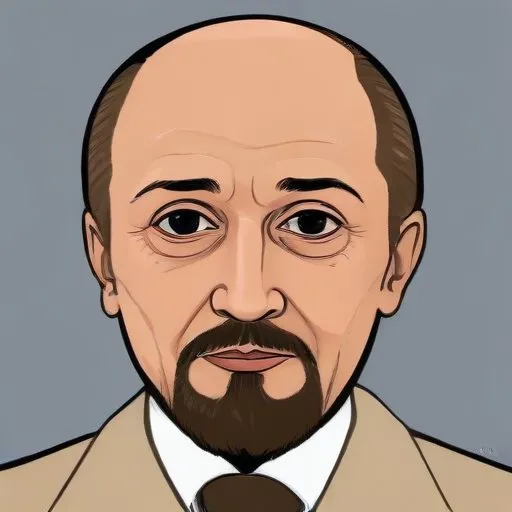
A Russian linguist and historian who made significant contributions to the study of Turkic languages and folklore, and is credited with developing the concept of "ethnolinguistics".
Viktor Maksimovich Zhirmunsky, a renowned Russian literary historian and linguist, left an indelible mark on the world of academia with his groundbreaking contributions to the fields of Russian formal studies, comparative literature, and cultural analysis. He is best known for his pioneering work on the epics of the Asian people of the Soviet Union, particularly the aqyn of Kazakh and Kyrgyz culture.
Born on August 2, 1891, in Saint Petersburg, Russia, to a Jewish family, Zhirmunsky was destined for greatness. He pursued his passion for languages and literature, earning his degree in German Romanticism from a prestigious Russian university. This foundation would later serve as the springboard for his exploration of diverse cultural traditions.
Zhirmunsky's academic trajectory was marked by his professorships at universities in Saratov and Leningrad, as well as his membership in the esteemed Academy of Sciences of the Soviet Union. As a representative of Russian formal studies, he played a crucial role in shaping the discipline. His critique of the ahistorical nature of formalism, as seen in his introduction to the translation of Oskar Walzel's Die künstlerische Form des Dichtwerkes (1919), significantly contributed to the evolution of literary analysis.
Following his relocation to Tashkent, Zhirmunsky shifted his focus to the study of Asian epics, delving into the rich cultural heritage of the Soviet Union's diverse ethnic groups. His work on the aqyn of Kazakh and Kyrgyz culture laid the groundwork for Yeleazar Meletinsky's subsequent research on the relationships between myth and epos.
Zhirmunsky's historical-typological theory, developed in response to the criticism of comparativism during the 1948 purge, posits that similarities between cultures arise from shared social and cultural institutions rather than historical influence. This innovative approach has had a lasting impact on the fields of comparative literature and cultural analysis.
Zhirmunsky's most notable work, Skazanie ob Alpamise i bogatyrskaya skazka (1960), showcases his expertise in the study of epics and cultural traditions. His contributions have left a lasting legacy, inspiring future generations of scholars to explore the complexities of human culture and literature.
Zhirmunsky's life was marked by significant milestones, including his evacuation to Tashkent during World War II and his eventual return to Leningrad. He passed away on January 31, 1971, leaving behind a rich cultural and intellectual heritage.
Through his remarkable life and work, Viktor Zhirmunsky has cemented his place as one of the most influential literary historians and linguists of the 20th century, his contributions continuing to inspire and enrich our understanding of human culture and literature.
Born in 1896
A pioneering linguist and theorist who developed groundbreaking concepts in phonology, morphology, and semiotics, shaping modern linguistics and literary theory.
Born in 1895
A Russian scholar and critic who developed a groundbreaking theory of narrative structure, identifying 31 fundamental elements that appear in all fairy tales, revolutionizing the study of folklore and literature.
Born in 1860
A Russian painter and illustrator renowned for capturing the serene beauty of landscapes and the fleeting effects of light, evoking a sense of melancholy and nostalgia.
