


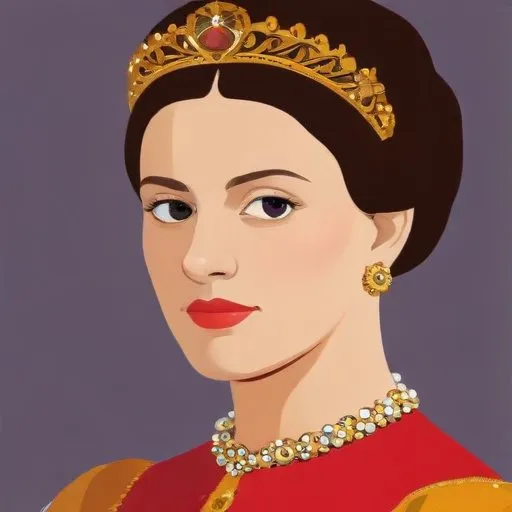
An Italian princess who married into the French royal family and was a patron of the arts, known for her beauty and cultural influence.
Virginia de Medici, a member of the illustrious House of Medici, is best known for her remarkable reign as the Duchess of Modena and Reggio, and her ability to protect the autonomy of the city of Modena from the attacks of the local Podest and Judge. As a regent, she demonstrated unwavering determination and leadership, earning her a place in the annals of history.
Born on May 29, 1568, in Florence, Virginia was the illegitimate daughter of Cosimo I de Medici, Grand Duke of Tuscany, and his mistress Camilla Martelli. Despite her illegitimate birth, Virginia's father legitimized her through a morganatic marriage with Camilla in 1570, allowing her to inherit the Medici name and legacy.
In 1586, Virginia was married to Cesare d'Este, Duke of Modena and Reggio, solidifying her position as Duchess and increasing her influence within the royal family. Following her husband's absence in 1601, Virginia took on the role of regent, demonstrating her remarkable capacity for leadership and diplomacy.
During her regency, Virginia faced opposition from the local Podest and Judge, who sought to undermine the city's autonomy. Through her cunning and strategic maneuvering, Virginia successfully defended Modena's independence, earning the respect and admiration of her contemporaries.
Virginia's life was not without its challenges. Her husband's infidelity took a toll on her mental health, leading to erratic behavior and eventually, a permanent mental illness that lasted until her death on January 15, 1615.
Virginia de Medici's extraordinary life serves as a testament to the often-overlooked contributions of women in power. Her remarkable leadership, determination, and loyalty to her family and city have left an indelible mark on the history of the House of Medici and the city of Modena.
In conclusion, Virginia de Medici's remarkable life is a testament to the power and resilience of women in positions of power. Her extraordinary story serves as a reminder of the importance of recognizing and celebrating the forgotten matriarchs of history.
Born in 1449
Renaissance leader who ruled Florence and sponsored artists like Michelangelo and Botticelli, shaping the city's cultural and artistic heritage.
Born in 1519
The Italian-French queen who married into the French monarchy and wielded significant power behind the scenes, known for her cunning politics and lavish court festivities. She sponsored the arts and architecture, leaving a lasting legacy on French culture.
Born in 1535
The second shortest-reigning pope in history, serving for just 27 days in 1605, he is most known for his brief but tumultuous papacy marked by power struggles and controversy.
Born in 1536
Led the Catholic Church during a tumultuous period, issuing papal bulls and playing a key role in the Counter-Reformation. He's also famous for his coffee habit, being the first Pope to try and approve of it.
Born in 1504
Leader of the Catholic Church during the Counter-Reformation, he excommunicated Queen Elizabeth I and played a key role in the Council of Trent.
