


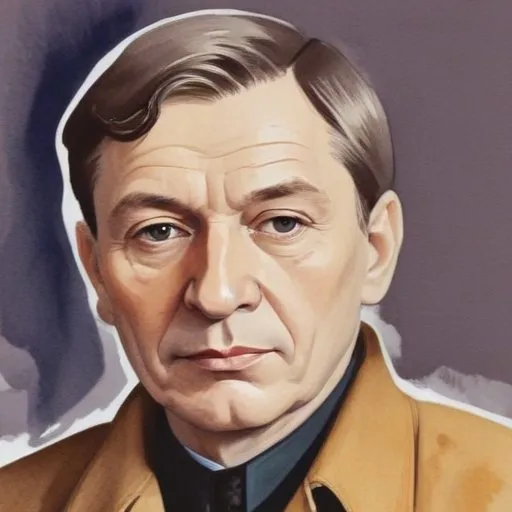
A dissident writer and satirist, known for his biting critiques of Soviet politics and society, often using absurdity and humor to expose the regime's flaws.
Vladimir Voinovich, a Russian writer and former Soviet dissident, is renowned for his piercing satirical novels that dared to critique the Soviet regime. His magnum opus, The Life and Extraordinary Adventures of Private Ivan Chonkin, is a scathing critique of Soviet politics and society during World War II, cementing his status as the first genuine comic writer produced by the Soviet system.
Born on September 26, 1932, in Stalinabad, Tajik SSR, Soviet Union, Voinovich's family was a complex mix of Serbian and Jewish descent. His father, a translator of Serbian literature, was arrested in 1936 on allegations of anti-Soviet agitation and spent five years in labor camps. This tumultuous childhood would later influence Voinovich's writing, as he drew from his experiences to craft biting social commentary.
Voinovich's literary journey began in Moscow, where he attempted to enter the prestigious Maxim Gorky Literature Institute. However, after a failed attempt, he enrolled in the Moscow Krupskaya Pedagogical Institute, faculty of history. During this period, he spent time in Kazakhstan, seeking inspiration, and upon his return to Moscow, he began working on his first novel.
Voinovich's early published works, We Live Here and I Want To Be Honest, hinted at his satirical prowess. However, it was the publication of the first part of The Life and Extraordinary Adventures of Private Ivan Chonkin in 1969 that brought him widespread recognition. This novel, which follows the misadventures of a hapless Russian soldier during World War II, was a scathing critique of Soviet politics and society.
The success of Chonkin was followed by a second part, further solidifying Voinovich's reputation as a daring satirist. However, this acclaim came at a cost: Voinovich was forced into exile and stripped of his citizenship by Soviet authorities in 1980.
During his exile, Voinovich continued to write, producing works that further critiqued the Soviet regime. One such work, Moscow 2042, a dystopian novel that envisioned a grim future for Russia, garnered international attention. Despite the adversity, Voinovich remained an outspoken critic of Russian politics, even after the fall of the Soviet Union.
In 1990, Voinovich was rehabilitated, and he returned to Moscow, where he continued to write and speak out against the Russian government's authoritarian tendencies. Throughout his life, Voinovich remained a vocal advocate for human rights and democracy, earning him the respect and admiration of readers worldwide.
Vladimir Voinovich's literary legacy is a testament to the power of satire as a tool for social commentary. His works continue to inspire writers and critics alike, offering a unique perspective on the complexities of Soviet politics and society. As a pioneer of satirical writing in Russia, Voinovich paved the way for future generations of writers to question authority and challenge the status quo.
Through his writing, Voinovich left an indelible mark on Russian literature, inspiring generations to come. His courageous critiques of Soviet politics and society serve as a beacon of hope for those who dare to challenge authority and fight for a better future.
Born in 1921
A Soviet physicist and dissident who advocated for human rights and nuclear disarmament, earning a Nobel Peace Prize in 1975. He's known for his courageous stance against the Soviet regime, promoting peace and democracy.
99 Years Old
A renowned Russian cellist and conductor, celebrated for his virtuosic performances and advocacy for human rights and freedom of expression. He was a prominent figure in the classical music world, known for his collaborations with prominent composers and musicians.
Born in 1924
A renowned Russian bard, known for his poignant lyrics and soothing melodies that captured the essence of Soviet life, inspiring generations of musicians and writers.
94 Years Old
A Russian physician, author, and academic who wrote influential novels that explored the complexities of Soviet life, blending literary styles and genres. His works often touched on themes of identity, morality, and social change.
93 Years Old
A prominent Russian poet and playwright, known for his bold and provocative works that often critiqued Soviet politics and society, earning him both acclaim and controversy.
Born in 1911
A Russian-American author who wrote novels that explored the human experience during Soviet times, particularly in his acclaimed novel "Children of the Arbat".
