


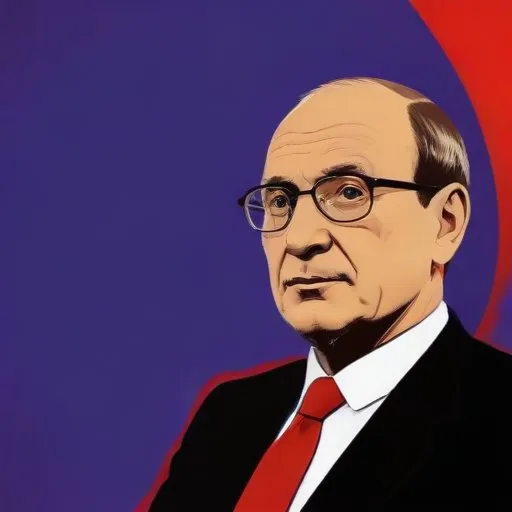
A Soviet politician and economist who played a key role in shaping the Ukrainian economy during the Soviet era, known for his efforts to industrialize and modernize Ukraine.
Vlas Yakovlevich Chubar was a Ukrainian Bolshevik revolutionary and Soviet politician, notoriously known for his role as the top Communist Party official in Ukraine during the devastating 1932-33 famine, which led to his eventual posthumous culpability for the events by a Ukrainian court in 2010. His tumultuous career was marked by a series of economic posts and senior positions in the Communist Party, ultimately ending in his arrest and execution in 1939.
Born on February 10, 1881, in Fedorvka, Yekaterinoslav Governorate, Russian Empire (now in Polohy Raion, Zaporizhzhia Oblast, Ukraine), Chubar was raised in an ethnic Ukrainian peasant family. His parents, illiterate peasants who owned a small plot of land, instilled in him a sense of revolution, which would shape his future. At the tender age of 13, Chubar was arrested and beaten by gendarmes for belonging to a revolutionary group, foreshadowing his future as a Marxist revolutionary.
After leaving school, Chubar worked as a roofer before joining the Bolshevik faction of the Russian Social Democratic Labor Party in 1907. He rapidly rose through the ranks, becoming a senior figure in Vesenkha in Moscow and the Urals between 1918-20. His return to Ukraine in 1920 marked the beginning of his prominent career in the Ukrainian Soviet government. Chubar held various economic posts, including running the Don basin coal combine in 1922-23, and was a member of the Central Committee of the Communist Party of Ukraine in 1920-36, as well as its Politburo.
In 1923, Chubar replaced Christian Rakovsky as Chairman of the Ukrainian Sovnarkom, a position he held until 1934. During his tenure, he attempted to resist Moscow's control over Ukraine, objecting to the appointment of Vyacheslav Molotov as secretary of the Ukrainian communist party in 1920. Despite this, Chubar's government was approved by the Eighth (1924) and the Tenth (1927) All-Ukrainian congresses of Soviets.
Chubar's career was cut short when he was arrested during the Great Terror of 1937-38 and executed in 1939. In 2010, a Ukrainian court posthumously held him culpable for his role in the 1932-33 famine, which resulted in the deaths of millions of Ukrainians. Despite his controversial legacy, Chubar remains an important figure in Ukrainian and Soviet history, serving as a cautionary tale about the dangers of unchecked power and ideological extremism.
Vlas Chubar's life and legacy serve as a poignant reminder of the devastating consequences of ideological extremism and the importance of accountability in politics. Despite the controversy surrounding his actions, Chubar remains an important figure in Ukrainian and Soviet history, deserving of nuanced examination and reflection.
Born in 1878
The Soviet Union's ruthless leader who ruled with an iron fist, implementing policies that led to widespread famine and purges, while also playing a crucial role in defeating Nazi Germany in World War II.
Born in 1890
A Soviet Minister of Foreign Affairs who played a crucial role in shaping the country's foreign policy during World War II and the early Cold War era, known for his diplomatic skills and signature cocktails.
Born in 1893
A Soviet politician who played a key role in Stalin's government, overseeing massive industrialization and infrastructure projects, while also being responsible for brutal suppression of dissent.
Born in 1888
A prominent figure in the Russian Revolution, he was a key architect of the Soviet economy and a vocal critic of Stalin's regime, ultimately falling victim to his purges.
Born in 1895
A skilled politician who played a crucial role in Soviet politics, serving as the head of state and a close ally to Soviet leaders, including Stalin and Khrushchev. He's known for his adaptability and ability to navigate the treacherous waters of Soviet politics.
Born in 1896
A high-ranking Soviet politician and ideologue who played a key role in shaping the country's cultural and artistic policies, particularly during the post-WWII era.
Born in 1894
The Soviet leader who initiated reforms and denounced Stalin's regime, known for his bold policies and iconic shoe-banging incident at the UN.
