


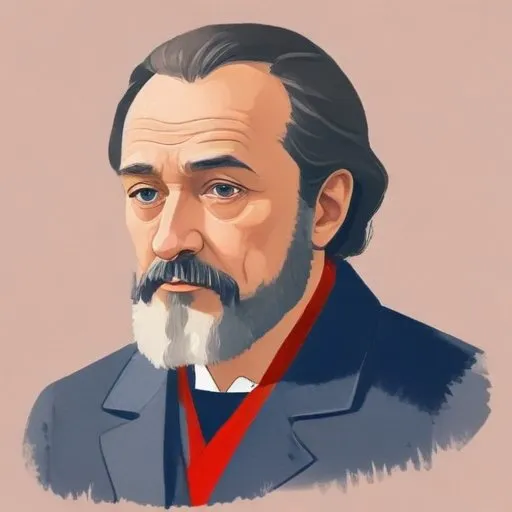
A leading figure in the Russian Symbolist movement, known for his mystical and philosophical poetry and plays that explored the intersection of art and spirituality.
Vyacheslav Ivanov was a renowned Russian poet, playwright, Classicist, and literary theorist, best known for his pivotal role in the Russian Symbolist movement. His innovative works and philosophical contributions have had a profound impact on modern literature and theatre.
Born on February 16, 1866, into the lower Russian nobility, Ivanov was a multilingual individual who studied Classics, philology, and philosophy. His early life was marked by a conventional upbringing, but it was his discovery of Friedrich Nietzsche's philosophy in Rome that sparked a transformation in his life and art.
Ivanov's personal life was marked by controversy and passion. He left his wife and daughter for the Afro-Russian poet Lydia Zinovieva-Annibal, with whom he had a tumultuous relationship. The couple's Orthodox ecclesiastical divorces and clandestine remarriage in a Greek Orthodox ceremony in Livorno added to the drama surrounding their union.
Ivanov's literary salon, held near the Tauride Palace in St. Petersburg, became a hub for Russian literary bohemians. He played a crucial role in discovering and mentoring talented poets, including Anna Akhmatova, Nikolai Berdyaev, Maria Skobtsova, and Boris Pasternak. His influence extended beyond Russia, with his dramatic theories inspiring avant-garde directors like Vsevolod Meyerhold.
Ivanov's theatrical philosophy sought to blur the fourth wall, making the audience an integral part of the performance. Drawing inspiration from Ancient Greek, Medieval, and Spanish Golden Age theatre, he aimed to create a more immersive experience. His radical ideas continue to influence modern theatre and performance art.
Ivanov's legacy extends far beyond his own literary output. He helped shape the Russian Symbolist movement, paved the way for future generations of writers and theorists, and left an indelible mark on modern literature and theatre. His influence can be seen in the works of contemporaries like Hugo von Hoffmannsthal and Max Reinhardt.
Ivanov received numerous accolades for his contributions to literature and theatre, including the prestigious Pushkin Prize.
Ivanov's life and work spanned a tumultuous period in Russian history, from the Silver Age of Russian Poetry to the aftermath of World War I. His legacy serves as a testament to the power of art and literature in shaping cultural discourse and inspiring future generations.
Born in 1880
A Russian literary giant, known for pioneering the avant-garde movement in literature, blending poetry and prose to create innovative, symbolic works that explored the human experience.
Born in 1893
A Russian avant-garde artist who revolutionized poetry and theater with his bold, futuristic style and passionate performances. He's most famous for his vibrant, propaganda-inspired posters and poems that captured the spirit of the Russian Revolution.
Born in 1892
A Russian poet and author who poured her heart into lyrical verses, exploring themes of love, nature, and the human condition. Her works are a testament to her intense emotional depth and poetic genius.
Born in 1890
A Russian literary giant, renowned for his poetic and novelistic masterpieces, including the epic "Doctor Zhivago", which captured the essence of Soviet Russia. His works are a testament to the power of literature in shaping cultural identity.
Born in 1889
A renowned poet and literary icon of the Soviet era, celebrated for her poignant and evocative works that captured the essence of love, loss, and resilience amidst war and oppression.
Born in 1899
A Russian-born novelist and critic, renowned for crafting intricate, lyrical prose and exploring themes of identity, morality, and the human condition through works like "Lolita" and "Pale Fire".
