


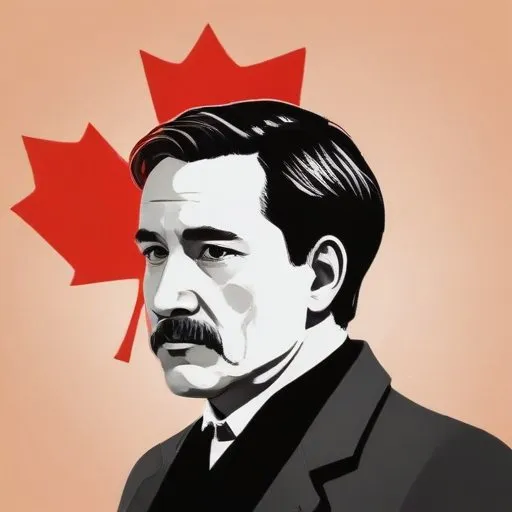
A Canadian geophysicist who made significant contributions to the field of seismology, and also wrote poetry that explored the intersection of science and art.
W. W. E. Ross was a Canadian geophysicist and poet who made significant contributions to the fields of geophysics and poetry. He is best known for being the first published poet in Canada to write Imagist poetry and later, surrealist verse, earning him the title of the first modern Canadian poet.
Ross was born on June 14, 1894, in Peterborough, Ontario, to Ralph and Ella Louise Ross (née Wrighton). He grew up in Pembroke, Ontario, and pursued his studies in geophysics at the University of Toronto. To support his education, Ross worked on geological surveys in Northern Ontario during the summer months.
Ross served as a private in the signal corps with the Canadian Expeditionary Force during World War I. After the war, he worked as a geophysicist at the Dominion Magnetic Observatory at Agincourt, Ontario (now part of Toronto), until his retirement.
Ross began writing poetry around 1923, initially experimenting with free verse and drawing inspiration from Imagism and Japanese poetry. In 1925, he developed the "laconic," a distinctly Canadian verse form that combined the essence of native poetry with a unique, unrhymed structure.
One notable evening in April 1928, Ross wrote the majority of his most famous work, "North," a series of laconics based on his memories of summers spent in Northern Ontario. He submitted some of the poems to Harriet Monroe's Chicago magazine Poetry and to Marianne Moore's magazine The Dial.
Ross married Mary Evelyn Lowrey, a well-known journalist, on June 3, 1924. The couple had two children, Mary Loretto and Nancy Helen, and lived in a family home on Delaware Avenue in Toronto, which would remain Ross's residence for the rest of his life.
Ross's innovative poetry and contributions to Canadian literature have made a lasting impact on modern poetry. His work has inspired generations of poets, solidifying his position as a pioneer in Canadian poetry.
Ross's poetry not only reflected his experiences as a geophysicist but also explored themes of Canadian identity, nature, and the human condition. His work has influenced Canadian literature, shaping the country's literary landscape.
Ross passed away on August 26, 1966, leaving behind a legacy of innovative poetry and contributions to the fields of geophysics and literature.
Born in 1908
Pioneering geologist and geophysicist who transformed our understanding of the Earth's surface, proposing the theory of plate tectonics and revolutionizing the field of geology.
Born in 1888
Pioneering Danish scientist who discovered the Earth's inner core and developed methods to study seismic waves, revolutionizing our understanding of the planet's internal structure.
Born in 1891
A pioneer in Bayesian statistics, he developed methods to quantify uncertainty and made significant contributions to our understanding of the Earth's interior and the behavior of celestial bodies.
