


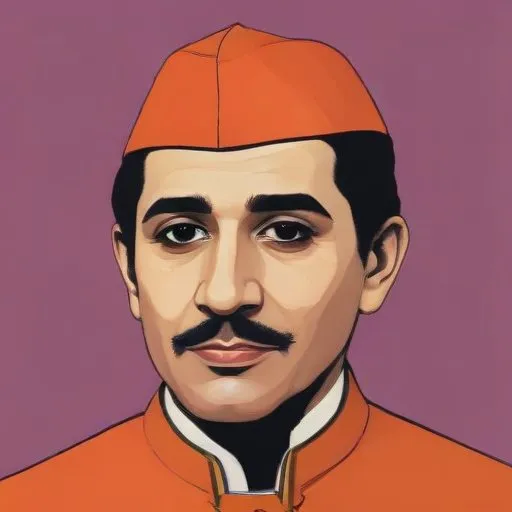
A Bengali aristocrat and philanthropist who contributed to the development of education and healthcare in Bangladesh, and is revered for his selfless charitable work.
Wajed Ali Khan Panni, affectionately known as Chand Mian, was a Bengali politician, educationist, and philanthropist who left an indelible mark on the landscape of Bengal during the late 19th and early 20th centuries. He is revered for his tireless efforts in promoting education, social reform, and community development, earning him a reputation as one of the most influential zamindars of his time.
Born on November 14, 1871, in Karatia, Tangail, Bengal Presidency, Panni was part of the esteemed Karatia Zamindari family, a wealthy landowning clan with Pashtun roots tracing back to Afghanistan during the Mughal period. Under the guidance of private tutors, he developed a strong foundation in Arabic, Bengali, English, Persian, and Urdu, laying the groundwork for his future endeavors.
Panni's career was marked by a series of milestones that showcased his commitment to education and community development. In 1892, he assisted the poet Naimuddin in translating the Fatawae-Alamgiri into Bengali, a feat that spanned four volumes. This early literary pursuit set the tone for his future endeavors, which would focus on promoting education and cultural awareness.
In the early 20th century, Panni initiated the construction of the Katakhali canal in Tangail, a project that greatly improved communication and connectivity in the region. He also collaborated with Abu Ahmad Ghuznavi Khan, the Zamindar of Delduar, to repair the historic Atia Mosque in 1909, a testament to his respect for his ancestral heritage.
One of Panni's most significant contributions was the founding of two schools in Karatia: Hafez Mahmud Ali Khan High School, named after his father, and Rokeya Aliyah Madrasah, named after his wife. These institutions provided much-needed education to the local population, cementing Panni's reputation as a champion of education.
Panni's philanthropic efforts were truly remarkable, with 20% of his income dedicated to charity work. As a compassionate landlord, he was known for his fairness and generosity towards his ryots (tenants), often waiving rent during times of natural disasters like famines or floods.
In 1926, Panni founded Saadat College, one of the country's first five university colleges, and the first college in rural Bengal. This institution went on to become a beacon of learning, providing higher education to countless students from rural Bengal.
Wajed Ali Khan Panni's contributions to education, politics, and social reform have left a lasting impact on the fabric of Bengal's society. His legacy continues to inspire generations, serving as a testament to the power of visionary leadership and philanthropy.
Though Panni's life was marked by struggles and challenges, including his imprisonment during the Khilafat movement in 1921, his unwavering commitment to his principles and values earned him the respect and admiration of his contemporaries.
In conclusion, Wajed Ali Khan Panni's life was a testament to the transformative power of education, compassion, and visionary leadership. His contributions continue to shape the course of Bengal's history, leaving behind a legacy that will be cherished for generations to come.
Born in 1894
The 2nd Prime Minister of Pakistan, serving from 1951 to 1953, known for his efforts to establish a parliamentary democracy in Pakistan. He played a significant role in the country's early years, shaping its political landscape.
Born in 1873
A prominent lawyer and politician who played a key role in the Pakistan Movement and served as the country's Minister of Interior, known for his efforts to establish a separate homeland for Muslims in the Indian subcontinent.
Born in 1922
A Bangladeshi politician who served as the leader of the Jamaat-e-Islami party and was convicted of war crimes during the Bangladesh Liberation War. He was a key figure in opposing Bangladesh's independence from Pakistan.
Born in 1925
The first Prime Minister of Bangladesh, leading the country to independence from Pakistan in 1971, and playing a key role in shaping the nation's early years.
Born in 1920
Led the Bengali nationalist movement, guiding Bangladesh to independence from Pakistan, and is revered as the "Father of the Nation" for his role in shaping the country's identity.
90 Years Old
Led the Bangladesh Liberation War, establishing Bangladesh as an independent nation, and implemented economic and political reforms. He's a national hero, revered for his role in shaping the country's identity.
